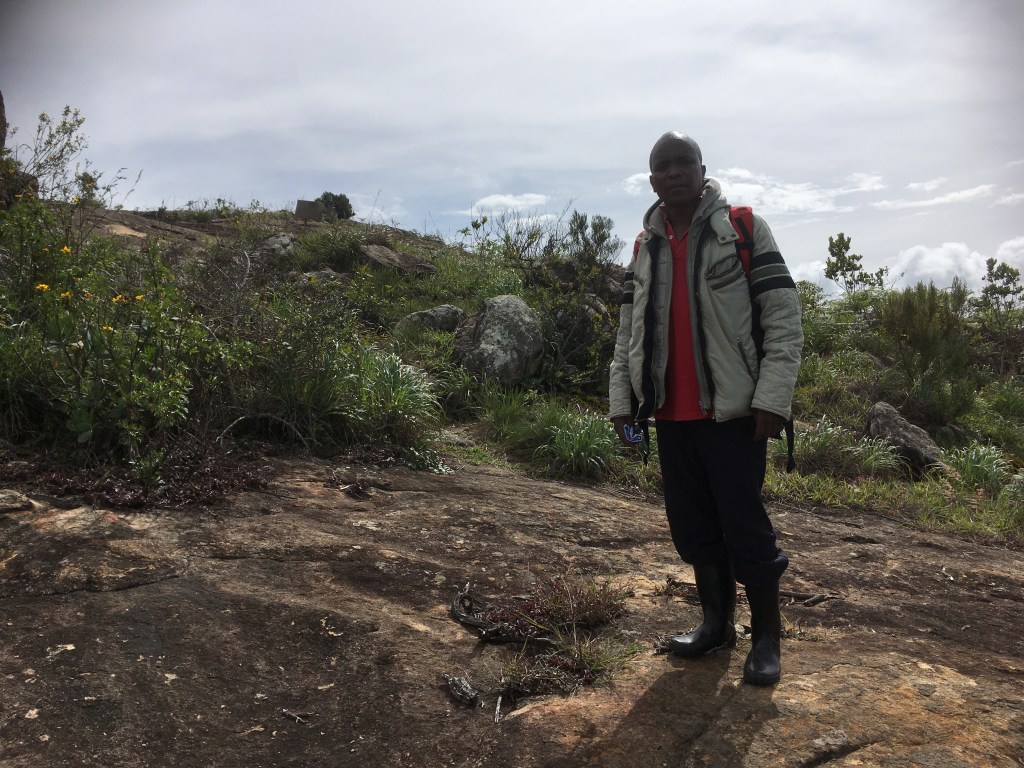
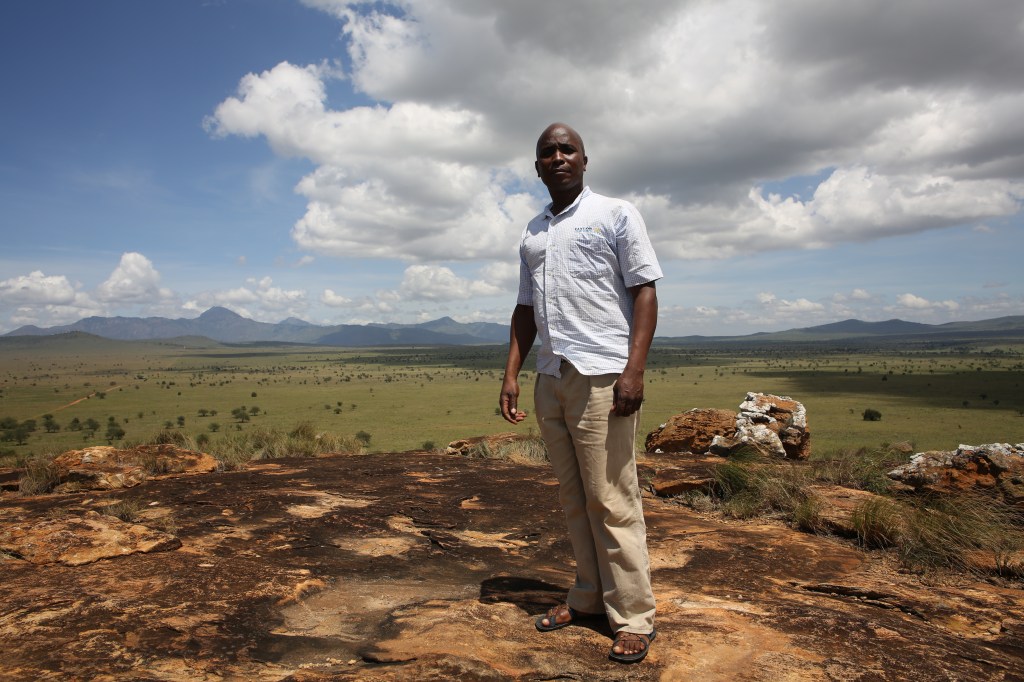
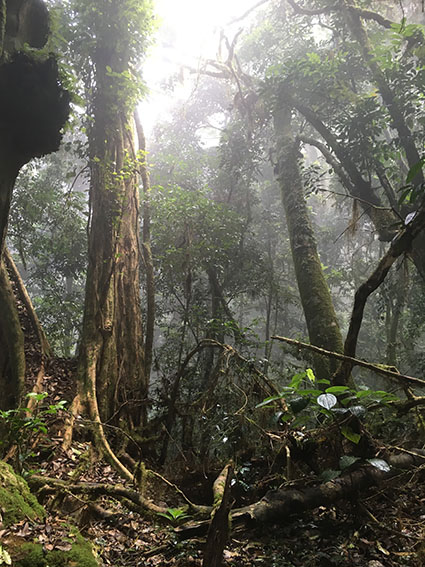
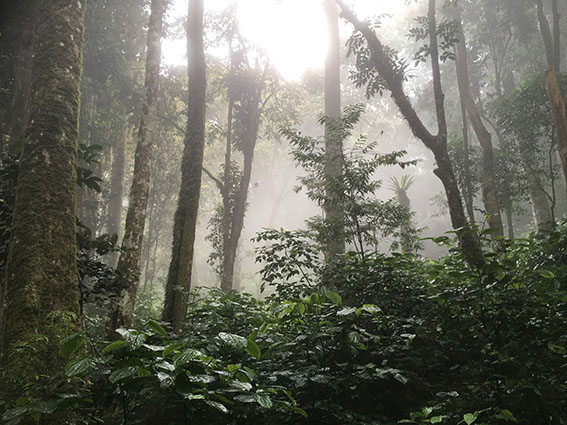
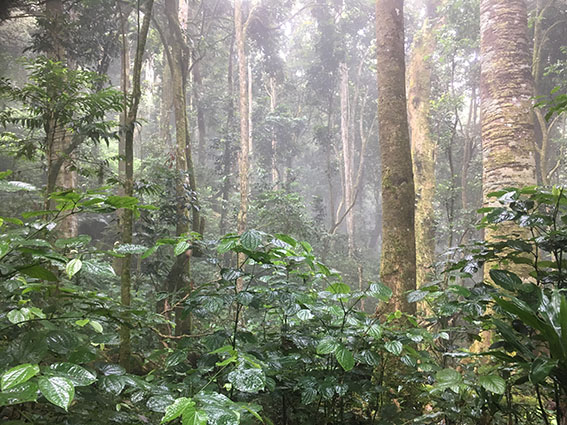
Guiding tours on the indigenous forests of Taita Hills, including Ngangao, Mbololo, Vuria, Chawia, and Iyale.
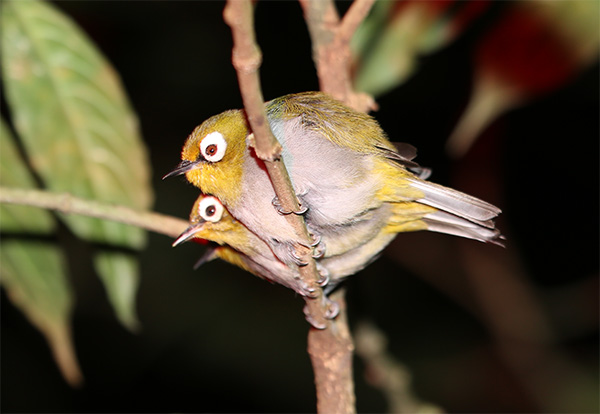
Taita white eye, endemic bird to Taita Hills
Also historical sites like Kenyatta caves, where first president of Kenya hide from colonialist, and Mwangeka caves where Mwangeka organized his group to fight against slavery in Taita Hills.
Birding
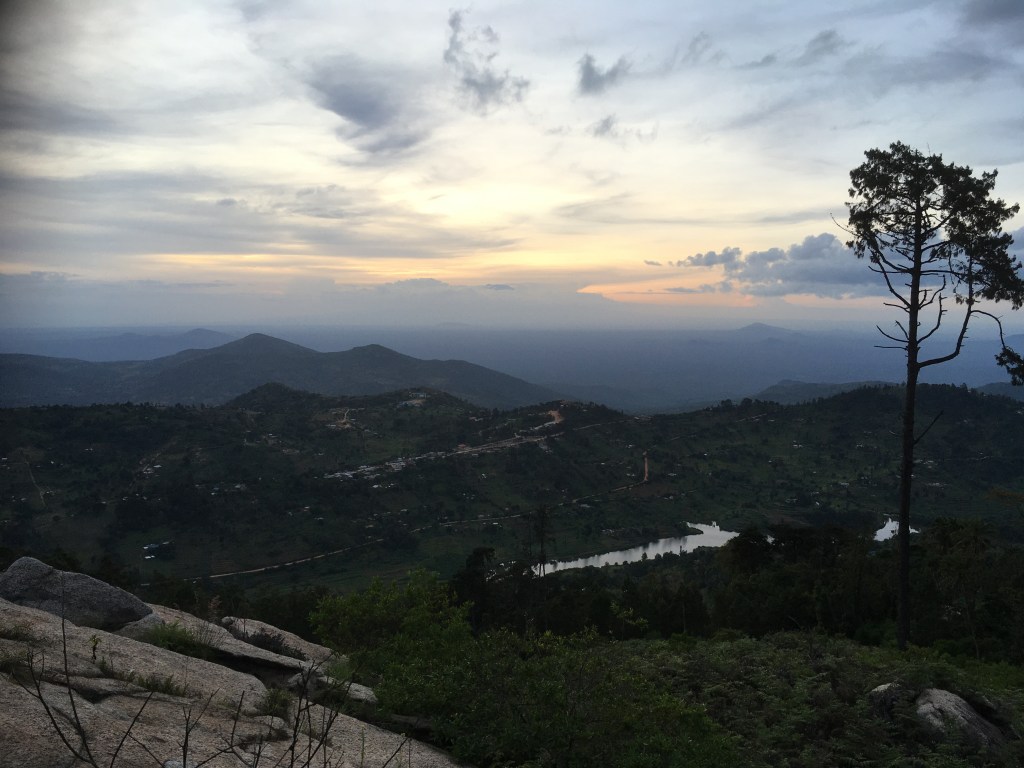
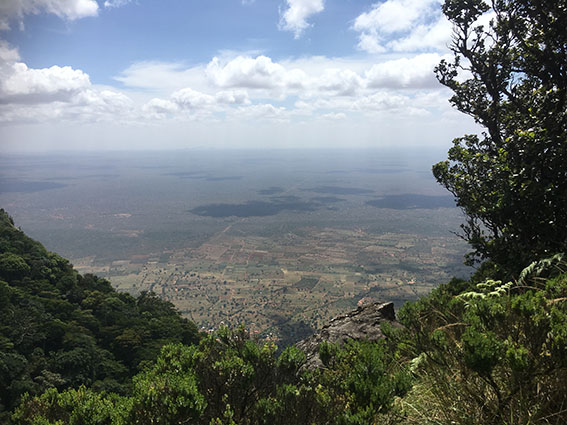
Beautiful scenaries to Tsavo and to Mt Kilimanjaro
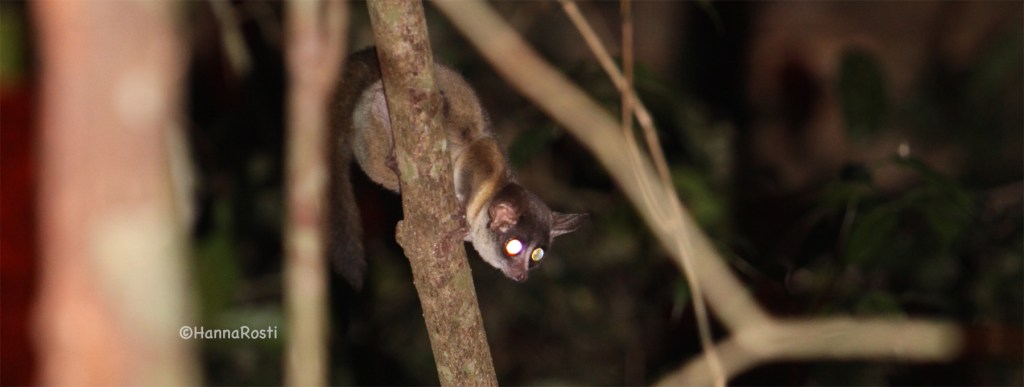
Nocturnal animals, tree hyraxes, greater galagos and dwarf galagos
Nocturnal mammals of Taita Hills are extremely interesting and loud at night. By using red light it is possible to observe them in their natural habitat. This is truly unforgettable experience. As there are no large predators in Taita Hills, walking in the forest at night is safe.
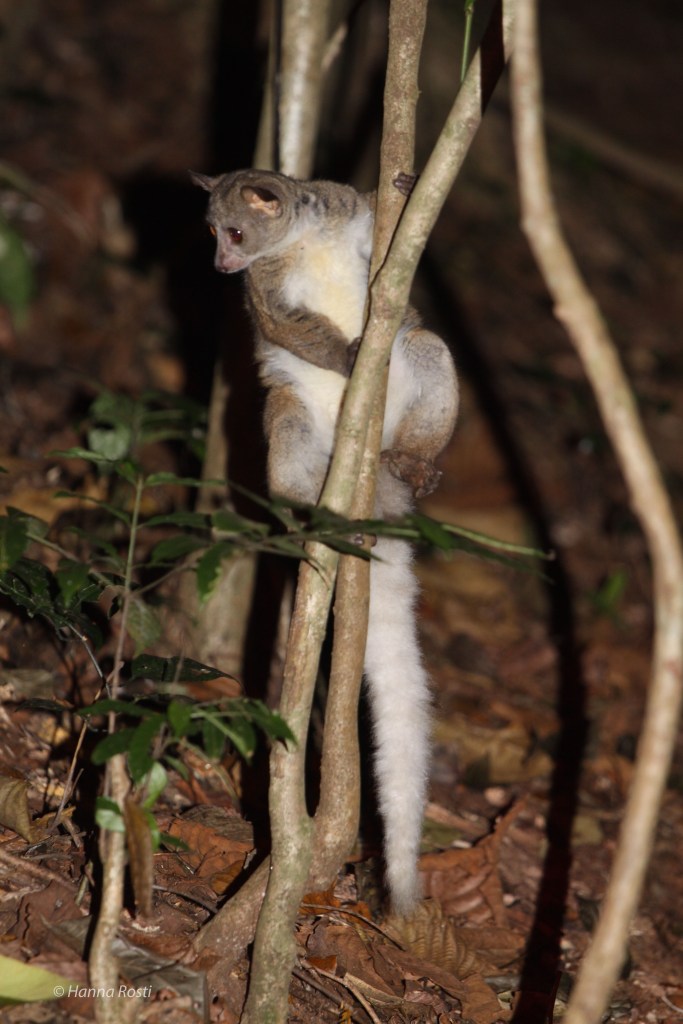
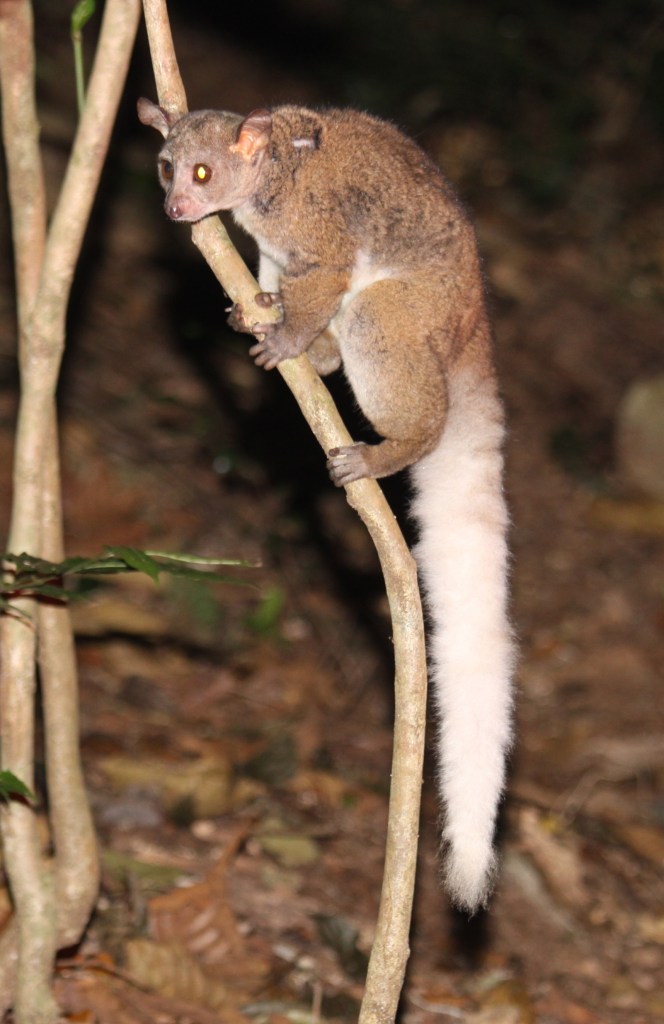
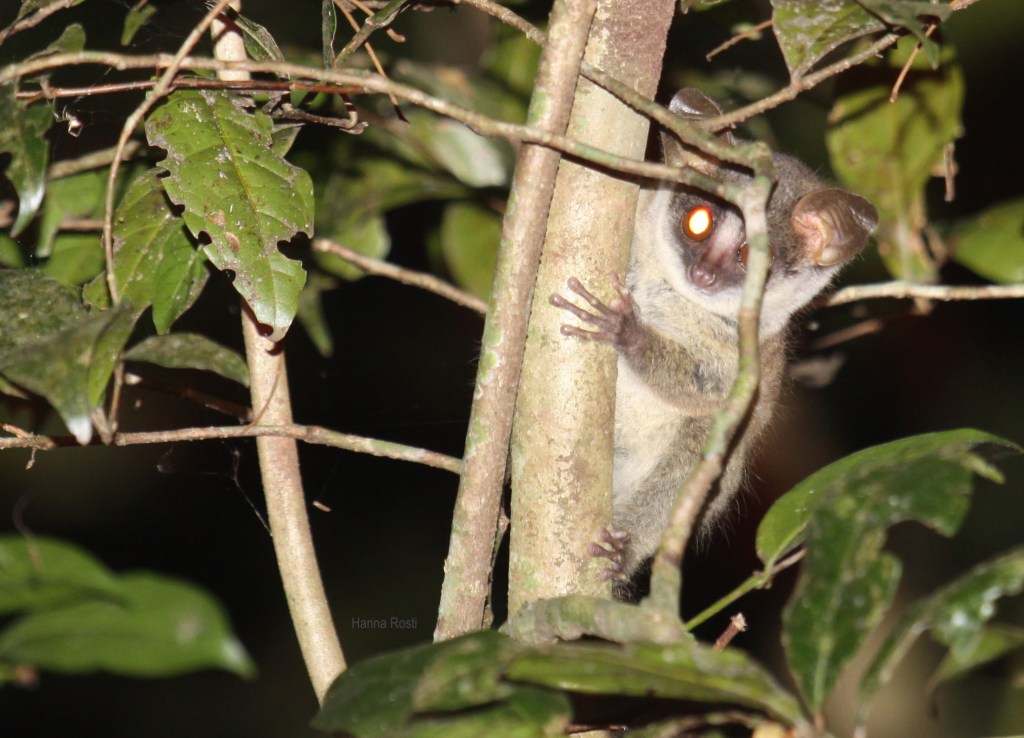
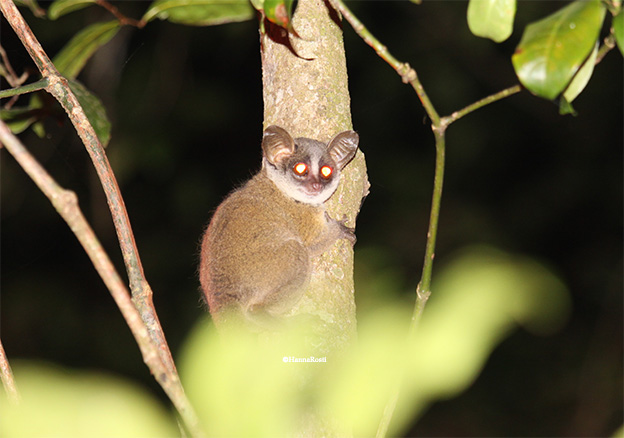
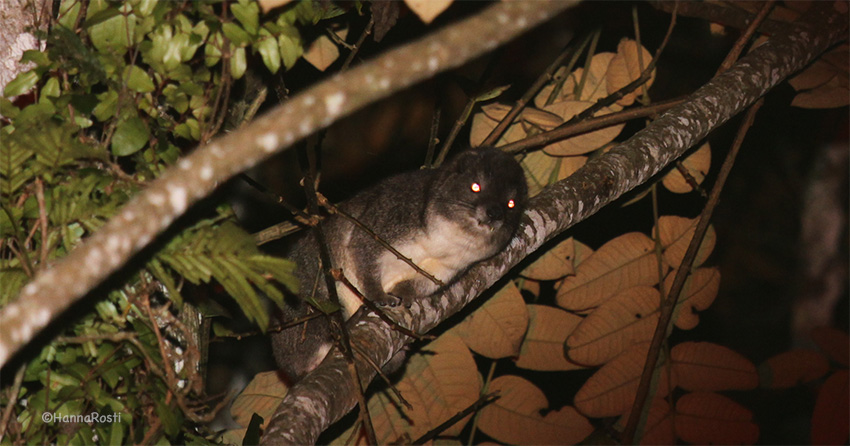
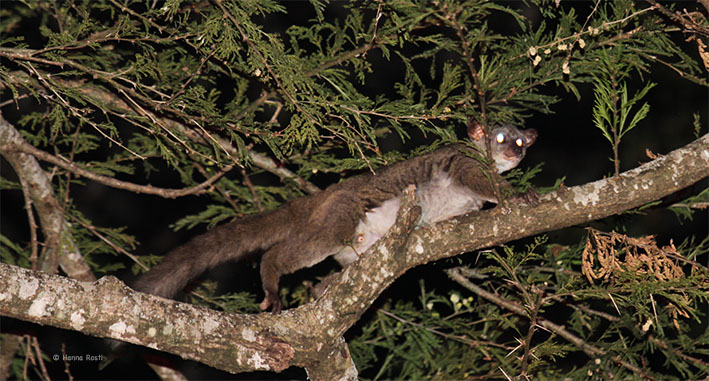
Small-eared greater galago in Ngangao Forest
I have 20 years of experience with working with researchers in many different fields, including e.g. forestry, bat research, botany and mammals of Taita Hills.
This article focuses on incredible variable acoustic communication of Taita tree hyrax. If you are interested in other peculiar features of tree hyraxes please read this previous article of Taita tree hyraxes.
Taita tree hyrax is believed to be undescribed species for the science based on these calls. For nocturnal cryptic animals, that are difficult to observe, call analysis has been the typical method of making taxonomic evaluation. Each species have their typical calls, especially calls that are used for so called ‘advertising’. These are calls that are used to draw attention of other con-species.
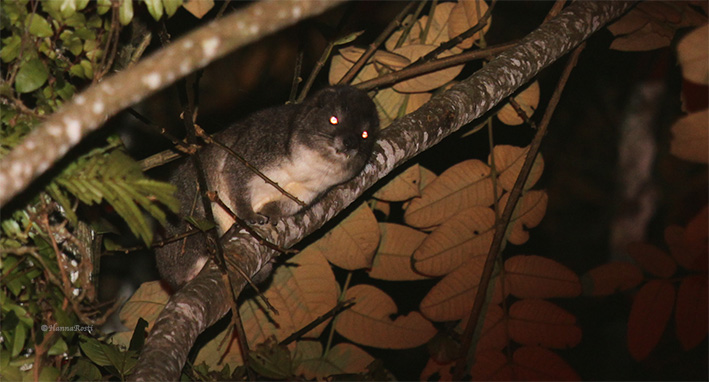
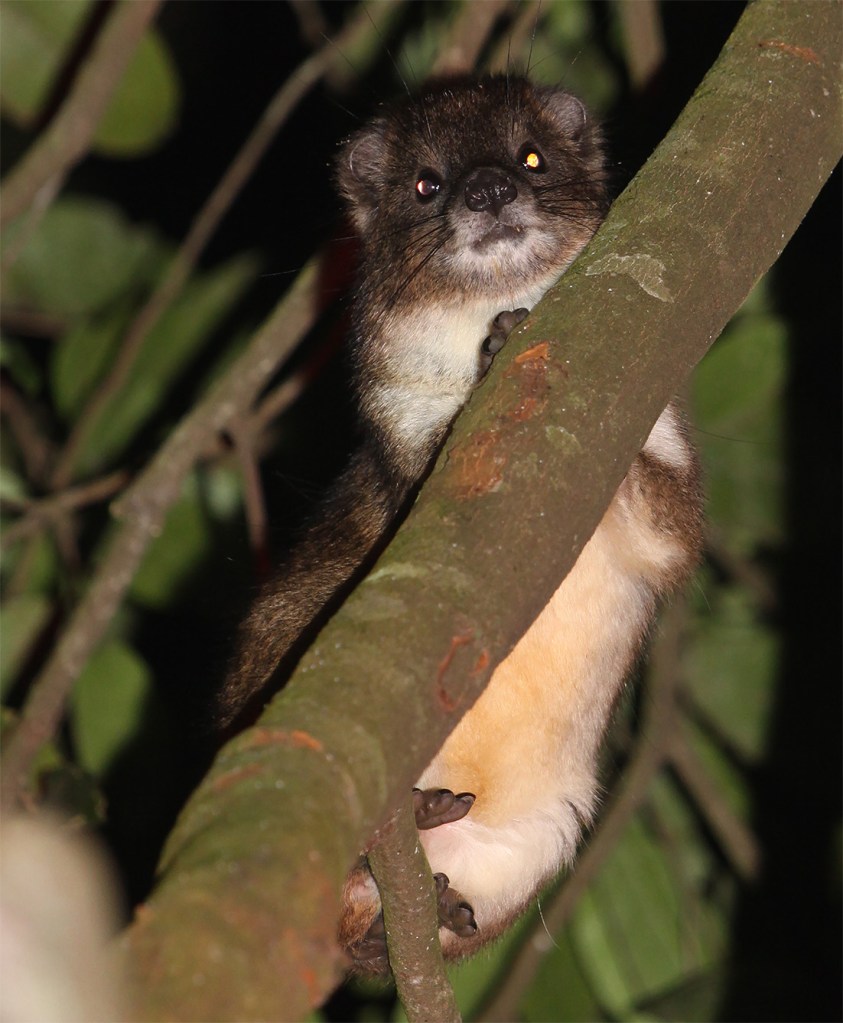
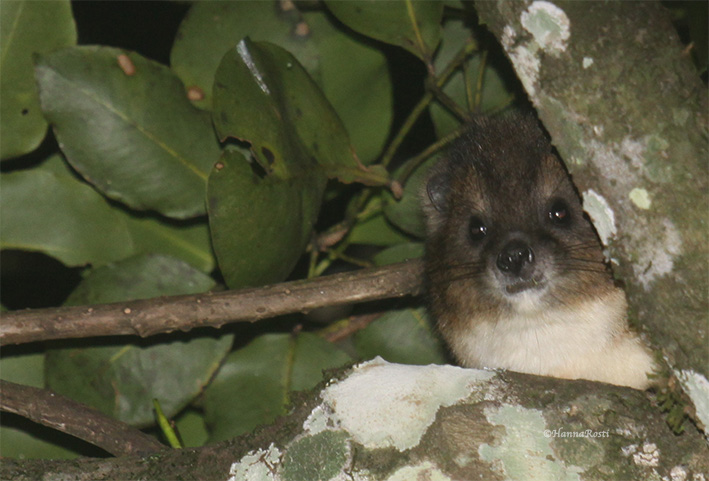
Taita tree hyrax female. Life of tree hyraxes are almost completely unknown. We don’t know if both sexes are calling, or are they just males. Tree hyraxes are believed to be solitary, but continues calling is difficult to explain for animal that is believed to be solitary.
Basic territorial call that is heard frequently in the forests of Taita Hills is ‘strangled thwack’. This call is most likely call that tree hyraxes use to claim their territory. Tree hyraxes eat leaves, and they are dependent on tree cavities for daytime sleeping sites.
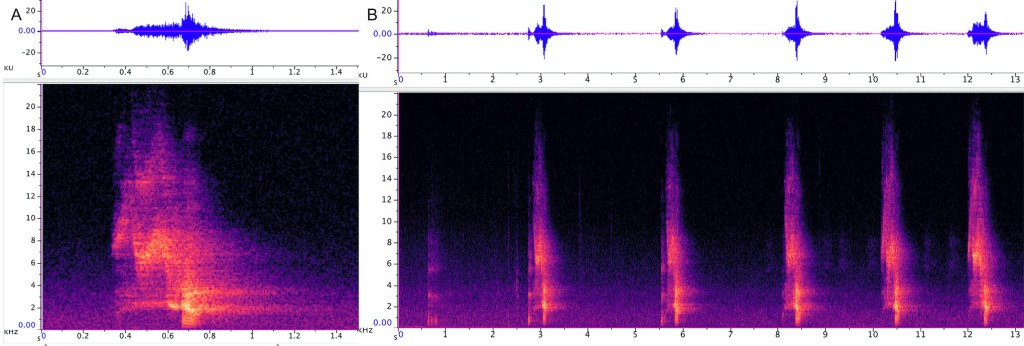
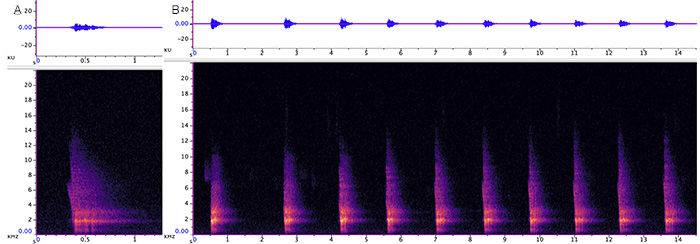
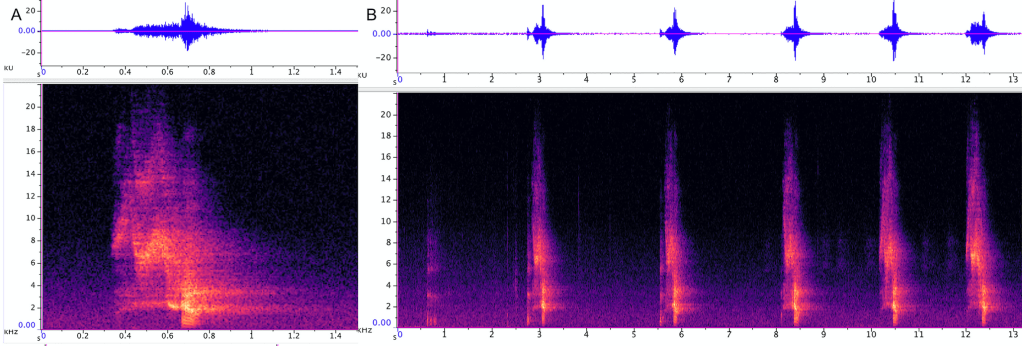
Strangled thwack is more than 100 dB call. Twist in the call, and noisy elements make sure that this call doesn’t go unnoticed.
Strangled thwacks are used in Taita Hills and in East Usambara Mountain. East Usambara Mountains are 160 km from Taita Hills. East Usambara Mountains are also part of Eastern Arch Mountains, and it is located in Tanzania.
Based on this very unique call type, Taita tree hyrax is believed to be tree hyrax species that is not yet described scientifically (Rosti et al. 2020).
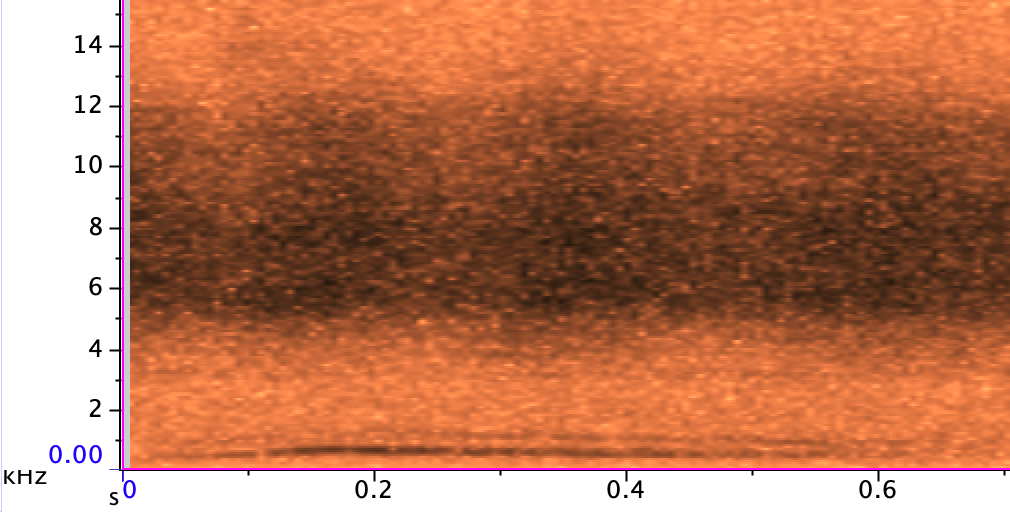
Strangled thwack call from Taita Hills. Horizontal axel time (s), vertical axel frequency (kHz) A) One strangled thwack call. Call duration about 1 s. Noticechanges (frequency modulation) in the strongest frequency of the call.B) Sequence of strangled thwacks. Usually tree hyraxes use these calls in about 10 call sequences where they counter call with other tree hyraxes.Strangled thwack sequence from one animal
Usually tree hyraxes are counter calling with each other.
TaitaTree hyrax counter-calling
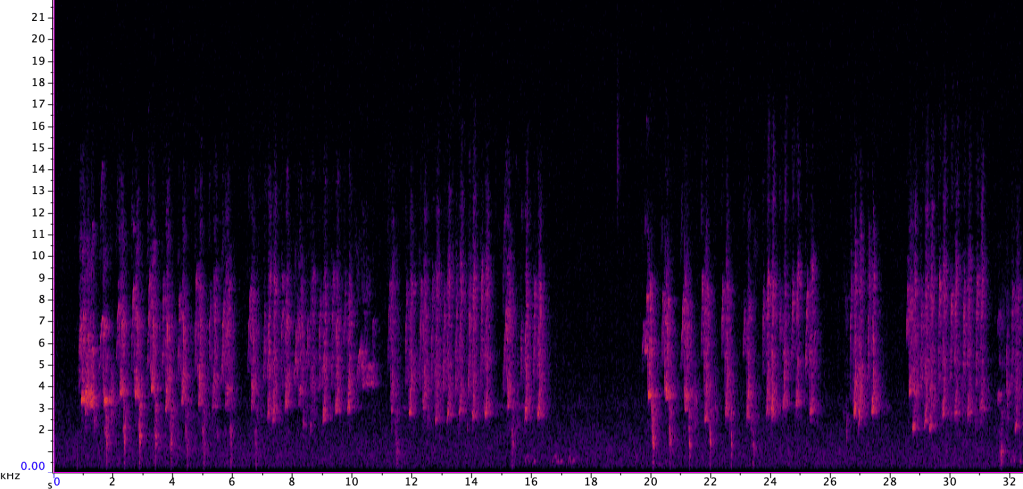
Another call type that tree hyraxes are using in Taita Hills is called hac. Hac call is used as territorial call. It is not quite as loud and frequency range is lower. Probably hac call is used when calling animal becomes little tired, or it want’s to use call type that is slightly less demanding.
Spectrograms of hac calls, time (s) on horizontal axel, frequency (kHz) on vertical axel.Hac call has smaller frequency range and it can be continued much longer, sometimes sequence may have more than hundred calls.
Songs from Taita tree hyrax
Taita tree hyrax sings songs. Songs have been previously found from rock hyrax (Procavia capensis) (Koren et al. 2008).
Singing mammals are very rare. Gibbons and whales sing. But I don’t know other singing mammals.
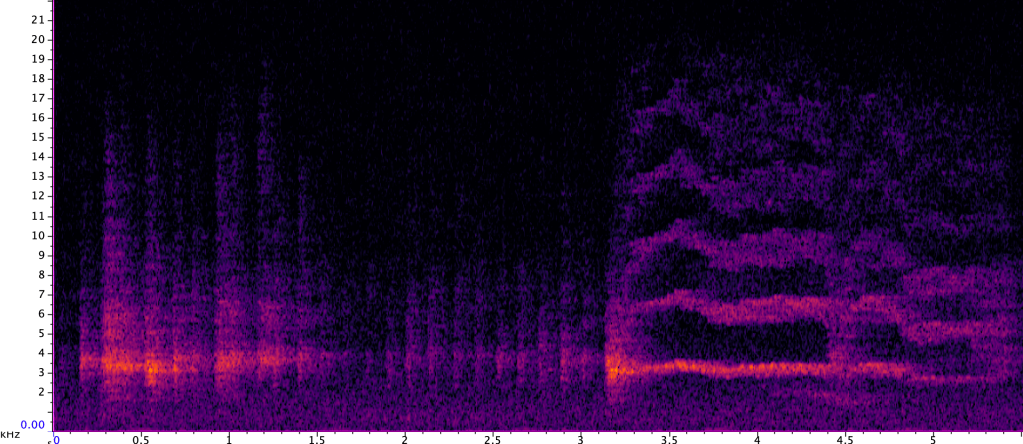
Singing Taita tree hyrax. Duration on horizontal axel (s) and frequency on vertical axel (kHz). These songs may last for more than 12 minutes.Sound sample from Taita tree hyrax song.Dendrohyrax song may begin like this.
Purpose of these songs are unknown. Probably they are used by males as they advertise their fitness for females that might be available for mating. In Taita Hills, remaining forests are packed with tree hyraxes and most likely all available territories are taken. It might mean that moving from one place to another could be difficult. Tree hyraxes may have to take a risk and come down to the ground where they are in greater danger to be hunted by genets. Acoustic communication is used as means to communicate with other tree hyraxes.
Tree hyrax wheezes, wheeze may be used as part of a song or aloneTaita tree hyrax wheezes with katytids on the background
More reading about tree hyraxes:
Demartsev, Vlad, Arik Kershenbaum, Amiyaal Ilany, Adi Barocas, Einat Bar Ziv, Lee Koren, and Eli Geffen. 2014. “Male Hyraxes Increase Song Complexity and Duration in the Presence of Alert Individuals.” Behavioral Ecology 25 (6): 1451–58. https://doi.org/10.1093/beheco/aru155.
Hoeck, Hendrik. 2017. “Some Thoughts on the Distribution of the Tree Hyraxes (Genus Dendrohyrax) in Northern Tanzania.” Afrotherian Conservation, no. 13: 47–49.
IUCN. 2014. “Dendrohyrax Validus: Hoeck, H., Rovero, F., Cordeiro, N., Butynski, T., Perkin, A. & Jones, T.: The IUCN Red List of Threatened Species 2015: E.T136599A21288090.” International Union for Conservation of Nature. https://doi.org/10.2305/IUCN.UK.2015-2.RLTS.T136599A21288090.en.
Koren, Lee, Ofer Mokady, and Eli Geffen. 2008. “Social Status and Cortisol Levels in Singing Rock Hyraxes.” Hormones and Behavior 54 (1): 212–16. https://doi.org/10.1016/j.yhbeh.2008.02.020.
Roberts, Diana, Elmer Topp-Jørgensen, and D.C. Moyer. 2013. “Dendrohyrax Validus Eastern Tree Hyrax.” In Mammals of Africa Vol I. Vol. 2013. Bloomsbury.
Article published 14.12.2020 in MDPI journal Diversity
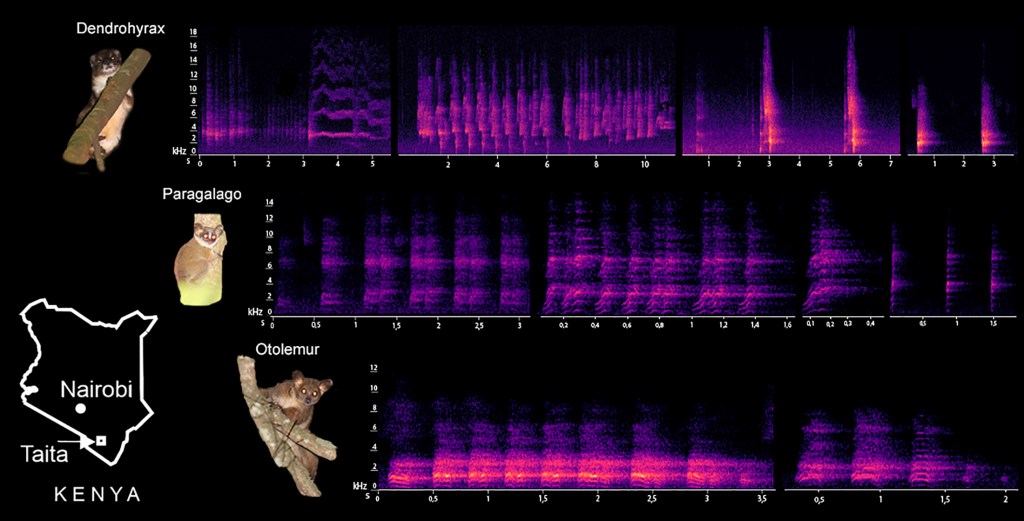
This article describes acoustic communication of Taita tree hyrax (Dendrohyrax), dwarf galago (Paragalago) populations living in Taita Hills and small-eared greater galago (Otolemur garnettii lasiotis) population.
This article is written by Hanna Rosti, Jouko Rikkinen, Henry Pihlström, Simon Bearder and Petri Pellikka.
Main findings:
Tree hyraxes from Taita Hills most likely belong to previously undescribed species. This is based on call named ‘strangled thwack’ that is not heard from other tree hyrax species.
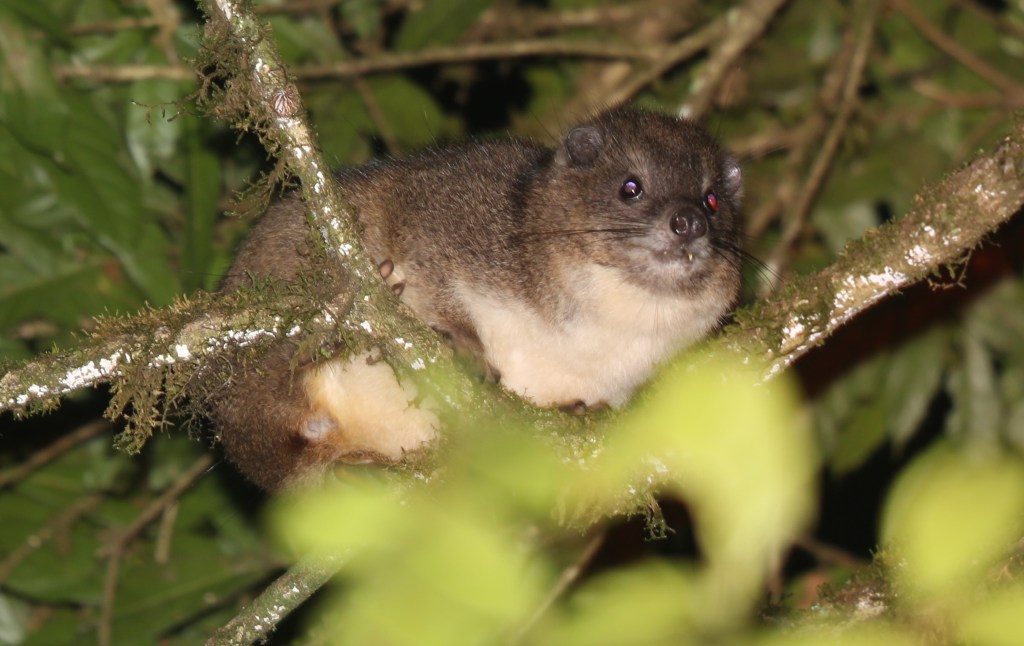
Tree hyrax female from Taita Hills
Spectrogram image of strangled thwack
Sound sample of strangled thwack
2. Taita tree hyraxes sing, these songs may last more than 12 minutes. In these songs several different syllables are combined in different order. Most likely these songs are used by males to attract females.
Tree hyrax song sample from Taita Hills
3. The other dwarf galago population is Kenya coast dwarf galago population (Paragalago cocos). This population is almost extinct with only about 10 individuals.
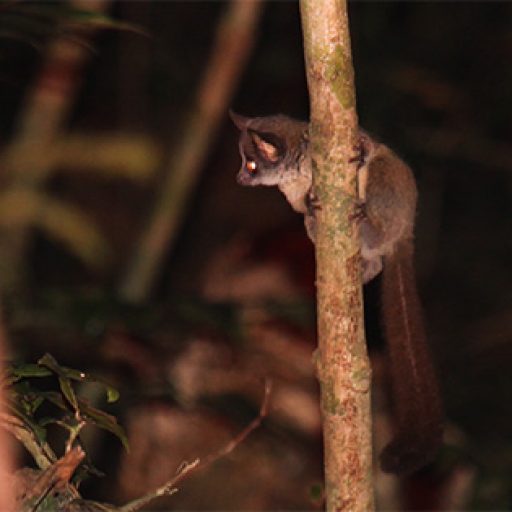
Kenya coast dwarf galago is living on mountain of Taita Hills.
Spectrogam of dwarf galago calls from Taita Hills
Recording from population believed to be Kenya coast dwarf galago in Taita Hills
4. Small-eared greater galagos in Taita Hills belong to subspecies Otolemur garnettii lasiotis. This was confirmed by comparing acoustical analysis from different subspecies.
Young male O. g. lasiotis with very white tail from Taita Hills
Metsät pienenivät ja jäivät kuin savannien ympäröimiksi saariksi
Noin viisi – kolmr miljoonaa vuotta sitten vaihtelevat kuivien jaksojen kaudet Itä-Afrikassa johtivat laajojen metsien muuttumiseen savanneiksi. Nämä muutokset seurailivat jääkausia, vaikkei Afrikassa jäätymistä laajemmassa mittakaavassa tapahtunutkaan.
Jäljelle jääneet metsät jäivät eristyksiin toisistaan, niitä ympäröi kuiva savanni jota metsien lajit eivät voineet ylittää. Metsiä jäi Eastern Arc Vuorien huipuille ja rannikon kosteammille alangoille.
Itäisessä Afrikassa kuivumisen seurauksena metsiä jäi vain Itäisten Kaarivuorten rinteille ja huipuille. Huippuja ympäröi savanni, jota metsissä elävät lajit eivät voi ylittää.
Metsien isolaatio johti Itä-Afrikan metsien eläin- ja kasvilajien lajiutumiseen. Hyvin pieneltä alueelta Keniasta ja Tansaniassa tavataankin poikkeuksellisen suuri määrä lintu-, nisäkäs-, sammakko- ym. lajeja. Tämä alue on yksi maailman biodiversiteetin Hot Spot aluesta.
Pikkugalagoiden lajiutuminen
Pikkugalagot ovat yöeläimiä, enimmäkseen hyönteissyöjiä, pieniä (alle 150g) ja ketteriä hyppijöitä. Jotkut lajit ovat hyvin arkoja ja vaikeasti löydettäviä. Siten Taitavuorten pikkugalagotkin saattoivat elää pienissä metsäsaarekkeissa pitkään ihmisten tietämättä niistä lainkaan.
Galagot ovat puoliapinoita kuten makit Madagasgarilla ja tarsierit Aasiassa. Puoliapinat ovat kädellisiä, mutta niitä pidetään ns. ”vähemmän kehittyneinä” kuin muita kädellisiä. Lemurit, lorit, tarsierit ja galagot ovat puoliapinoita.
Afrikassa kaikki puoliapinat ovat galagoita ja yöeläimiä. Ilmeisesti kilpailu muiden kädellislajien kanssa on johtanut niiden yöaktiivisuuteen.
Pikkugalagoiden taksonomia, lajintunnistus, on ollut tutkijoille haastavaa. Nämä yöaktiiviset lajit ovat kryptisiä, eli eri lajit näyttävät keskenään samanlaisilta. Öisessä metsässä eri lajit tunnistavat toisensa kutsujen perusteella, eivät ulkonäön perusteella (Bearder 1999).
Pitkän matkan kutsuhuudot ovat helpoin tunnistaa lajit toisistaan, sillä kullakin lajilla on oma tunnusomainen kutsuhuuto. Pikkugalagot käyttävät näitä kutsuhuutoja aamuisin ryhmän kokoontuessa yön ruuanetsinnän jalkeen ja illalla ennen hajaantumista metsään. Kutsuhuutoja käytetään myös yönaikana, huudoilla ylläpidetään yhteyttä ryhmän jäseniin.
Pikkugalagoiden taksonomia perustui aluksi museoihin kerättyihin kuolleisiin yksilöihin. Myöhemmin taksonomia perustui myös kutsuhuutojen analysointiin, lajien käyttäytymisen ja eliömaantieteelliseen tutkimukseen. Viime vuosina DNA tutkimus on tuonut paljon lisätietoa pikkugalagoiden taksonomiasta (Pozzi et al. 2020).
Suku – Paragalago (2017) Itäisen Afrikan pikkugalagot
Pikkugalagoiden, suku Galagoides uudelleenarvioitiin vuonna 2017 (Masters et al. 2017). Tutkimus perustui genetiikan, ääntelyn ja morfologian vertailuun. Tutkimuksen perusteella suku Galagoides jaettiin kahtia, ja Itä-Afrikan pikkugalagoiden suvun nimeksi tuli Paragalago. Galagoides suku koostuu kolmesta lajista, jotka elävät varsin laajalla alueella Länsi-Afrikassa. Lajit ovat G. demidoff,G. thomasi ja G. kumbirensis. G. kumbirensis löydettiin Angolasta ja kuvattiin lajina vasta vuonna 2017 (Svensson et al. 2017).
Uuteen Paragalago sukuun kuuluu, tällä hetkellä, viisi lajia. Nämä lajit ovat Kenian rannikkopikkugalago (P. cocos), Zanzibarin pikkugalago (P. zanzibaricus),Mosambicin pikkugalago (P. granti), vuoristopikkugalago (P. orinus) ja Rondon pikkugalago (P. rondoensis).
On mahdollista, että lajeja on enemmänkin, sillä monet populaatiot ovat olleet pitkään eristyneinä. Syvällisempää pikkugalagotutkimusta ei ole tehty kovinkaan paljoa, Taitavuorten pikkugalagojakaan ei ole tutkittu ennen nyt alkanutta tutkimustamme. Koska Taitavuorten pikkugalago saattaa olla P. cocos (Rosti et al. 2020), Kenian rannikkopikkugalago, tämä artikkeli keskittyy erityisesti P. cocos lajin taksonomiaan.
Taitavuorten pikkugalagolaji on edelleen arvoitus. Se kuulostaa Kenian rannikkopikkugalagolta, mutta elää täysin erilaisessa elinympäristössä vuorten huipuilla.
Rajat lajien välillä eivät ole yksinkertaisia, ja tutkimuksissa täytyy yhdistää tutkimustuloksia morfologiasta, käyttäytymisestä, akustisesta kommunikaatiosta, eliömaantieteestä ja genetiikasta. Jokaisen populaation suojelu on tärkeää, mutta lajin tunnistus voi auttaa saamaan lisää resursseja suojeluun. Suojelutoimet kohdennetaan helpommin lajeihin, jotka ovat uhanalaisia Kansainvälisen luonnonsuojeluliiton IUCN punaisessa kirjassa. Siten oikea uhanalaisuusluokitus saattaa pelastaa populaation sukupuutolta.
Paras tietolähde pikkugalagoihin (ja muihinkin Afrikan eläimiin) on Mammals of Africa sarja (MOA) (2013), ja pikkugalagot löytävät osasta II. Kunkin lajin ääntelyä voi kuunnella Wildsolutionsin nettisivuita. Tämä sivusto on Eastern Africa Primate Diversity and Conservation Program, jota ylläpitävät tutkijat ja luonnonsuojelijat Thomas Butynski ja Yvonne de Yong.
Paragalagolajien elinalueet ja painot lyhyesti (Names IUCN 2019)
P. cocos: Kenian rannikkopikkugalago, Kenya coast galago, coast of Kenya, 138-150 g.
P. zanzibaricus: Zanzibarin pikkugalago, Zanzibar dwarf galago, lowland forests at the coast of Tanzania, 118-195 g.
P. zanzibaricus zanzibaricus: Zanzibar island, saarella elävät yksilöt ovat pienempiä
P. zanzibaricus udzunwensis: Matundu dwarf galago, useat Tansanian alankometsät lähellä rannikkoa
P. granti: Mosambicin pikkugalago, Wozambique dwarf galago, eteläinen Tanzania, Malawi, Zimbabwe ja Mosambique, 165 g.
P. orinus: Vuoristopikkugalago, Mountain dwarf galago, Uzzungwa ja Uluguru vuoret Tansania, 74,98 g. Yksi maailman 25 uhanalaisimmasta kädellisestä IUCN:n ja IPS:n mukaan.
P. rondoensis: Rondon pikkugalago, Rondo dwarf galago, tavataan kuudesta eristyneestä alankometsän saarekkeesta Tansanian rannikolla, 60-73g.
P. cocos, Kenya coast galago, nimeämisen historia
Thomas Butynski kollogoineen kirjoitti yhteenvetoartikkelin Itä-Afrikan pikkugalagoiden taksonomiasta (Butynski et al. 2006). Siihen aikaan itäistenkin lajien suku oli Galagoides, selvyyden vuoksi käytän tässä kuitenkin sukua Paragalago.
Edmund Heller nimesi lajin 1912, Galago moholin alalajina. Hän keräsi 10 yksilöä Mazerasista Keniasta. Habitaatti, josta eläimet pyydystettiin oli matalampaa pusikkoa ja kookospalmuja.
P. cocos nostettiin omaksi lajikseen Elliotin toimesta 1913. Pitkän aikaa lajia kuitenkin pidettiin käytännössä Galago gallarumin alalajina (Galago gallarum cocos) tai Zanzibarin pikkugalagon alalajina (P. zanzibaricus cocos).
P. cocoksen käyttäytymistä, ääntelyä ja ekologiaa tutkittiin perusteellisesti Dianin ja Gedin metsissä Keniassa (Harcourt & Nash 1986a,b; Harcourt & Perkin 2013). Harcourtin ja Nashin artikkeleissa laji oli vielä nimetty P. zanzibaricukseksi, mutta tutkimus oli osoittamassa, että laji ei ollut P. zanzibaricus vaan P. cocos.
Dianin ja Gedin metsät ovat 40 kilometrin päässä Mazerazista, josta P. cocoksen lajimäärityksessä 1912 käytetyt yksilöt olivat kerätty. Thomas Butynski ja Yvonne de Yong kävivät Mazerasissa 2004 määrittämässä metsän pikkugalagoiden lajin, ja varmistivat että laji on P. cocos. Siis sama laji kuin Dianin ja Gedin metsissä.
Aiemmin julkaistujen tieteellisten artikkelien lukeminen voi tuntua hankalalta, sillä lajien nimet ovat vaihtuneet, ja myös suvun nimi on vaihtunut.
P. cocos oli P. zanzibaricus, tai jokin muu vuoteen 2006 saakka. Butynski et al. (2006) artikkelista saakka P. cocos on saanut pitää lajistatuksensa. Tämä lajistatus perustui pitkälti lajityypilliseen kutsuhuutoon, joka on selvästi erilainen kuin P. zanzibaricuksella. Lajin englanninkielinen nimi vaihtui jälleen viime vuonna, kun Kenya coast dwarf galago lajinimestä pudotettiin dwarf pois IUCN.n arvioinnissa. Siten lajin englanninkielistä nimeä ei voi pitää vakiintuneena.
Pikkugalagoiden lajieroja on etsitty nenän ja pään alueen värityksestä,vatsan ja selän värityksestä korvien pituudesta, ruumiinkoosta, hännän värityksestä ja pituudesta. Ongelmana on että populaatioiden sisällä on lähes yhtä paljon vaihtelua kuin lajien välillä. Ääntely on yksiselitteisempi tapa tunnistaa lajeja.
Kenian rannikkopikkugalagon (P. cocos) elinalueet
Kenian rannikkopikkugalagoa (P.cocos) tavataan ikivihreissä alankometsissä Kenian rannikolla, ja myös Tana jokea ylävirtaan seuraillen. Etelässä elinalue rajautuu Mgambon metsään Tansanian puolella ja koillisessa Itäisen Usambarara vuorten alarinteille (Harcourt & Perkin, 2013). Kenian rannikkopikkugalagoa tavataan 350 metrin korkeuteen saakka merenpinnasta.
P. cocos on näistä rannikolla elävistä lajeista pohjoisin, P. zanzibaricus keskimmäinen ja P. granti eteläisin laji. On mahdollista että P. cocos ja P. zanzibaricus elävät samoissa metsissä muutamissa metsissä Itäisillä Usambara vuorilla ja pohjoisessa Tansanian rannikkokaistaleella (Butynski et al. 2006).
Miksi pikkugalagolajeja tavataan niin paljon suppealta alueelta?
Ilmaston ja kasvillisuuden muutokset viiden viimeisen vuoden aikana johtivat laajojen metsien katoamiseen Itäisestä Afrikasta. Tämä sai aikaan myös hyppäyksen ihmisen evoluutiossa, ihmisen sopeutuessa elämään kuivemmalla ja kuumemmalla savannilla. Jäljelle jääneet metsät olivat eristäytyneitä laikkuja Itäisillä Kaarivuorilla, joista metsien lajisto sai turvapaikkansa. Nämä metsät ovat noin 30 miljoonaa vuotta vanhoja. Metsien hämmästyttävä monimuotoisuus on kokenut kovia erityisesti viimeisen sadan vuoden aikana, jolloin metsät on miltei hävitetty.
Itäisten Kaarivuorten metsät yhdessä Itä-Afrikan rannikon alankometsien kanssa muodostaa Zanj alueen, jossa on poikkeuksellisen monimuotoinen eliömaailma. Tällä alueella tulee olla kaikkein korkein suojeluarvo (Masters et al. 2017).
Pikkugalagoiden tutkijoita
Tässä joitakin tutkijoita, jotka ovat tehneet pikkugalagotutkimusta Itä-Afrikassa:
Simon Bearder, Thomas Butynski, Andrew Perkin, Yvonne de Yong,Magdalena Svensson, Caroline Harcourt, Leanne Nash, Paul Honess, Judith Masters, Anna Nekaris
Öinen pikkugalagotutkimus on vaikeaa, siten pikkugalagoista tiedetäänkin hämmästyttävän vähän verrattuna useimpiin muihin kädellisiin.
Pikkugalagot ovat kaikkialla Afrikassa vähenemässä niiden elinalueiden pienentyessä jatkuvasti. Monet Paragalago lajit ovat erityisen herkkiä, sillä ne vaativat alkuperäismetsää selviytyäkseen.
Lähteet:
Bearder SK. 1999. Physical and social diversity among nocturnal primates: A new view based on long term research. Primates 40:267–282. DOI: 10.1007/BF02557715.
Butynski TM, de Jong YA, Perkin AW, Bearder SK, Honess PE. 2006. Taxonomy, Distribution, and Conservation Status of Three Species of Dwarf Galagos (Galagoides) in Eastern Africa. Primate Conservation 21:63–79. DOI: 10.1896/0898-6207.21.1.63.
Harcourt CS, Nash LT. 1986a. Social organization of Galagos in Kenyan coastal forests: I.Galago zanzibaricus. American Journal of Primatology 10:339–355. DOI: 10.1002/ajp.1350100406.
Harcourt CS, Nash LT. 1986b. Species differences in substrate use and diet between sympatric galagos in two Kenyan coastal forests. Primates 27:41–52. DOI: 10.1007/BF02382521.
Harcourt CS, Perkin AW. 2013. Galagoides cocos Kenya Coast Dwarf Galago (Diani Dwarf Galago). In: Mammals of Africa. Bloomsbury,.
Masters JC, Génin F, Couette S, Groves CP, Nash SD, Delpero M, Pozzi L. 2017. A new genus for the eastern dwarf galagos (Primates: Galagidae). Zoological Journal of the Linnean Society 181:229–241. DOI: 10.1093/zoolinnean/zlw028.
Pozzi L, Penna A, Bearder SK, Karlsson J, Perkin A, Disotell TR. 2020. Cryptic diversity and species boundaries within the Paragalago zanzibaricus species complex. Molecular Phylogenetics and Evolution 150:106887. DOI: 10.1016/j.ympev.2020.106887.
Rosti H, Rikkinen J, Pellikka P, Bearder S, Mwang’ombe J. 2020. Taita Mountain dwarf galago is extant in the Taita Hills of Kenya. Oryx 2020:151–153. DOI: https://doi.org/10.1017/S003060531900142X.
Svensson MS, Bersacola E, Mills MSL, Munds RA, Nijman V, Perkin A, Masters JC, Couette S, Nekaris KA-I, Bearder SK. 2017. A giant among dwarfs: a new species of galago (Primates: Galagidae) from Angola: Svensson et al. American Journal of Physical Anthropology 163:30–43. DOI: 10.1002/ajpa.23175.
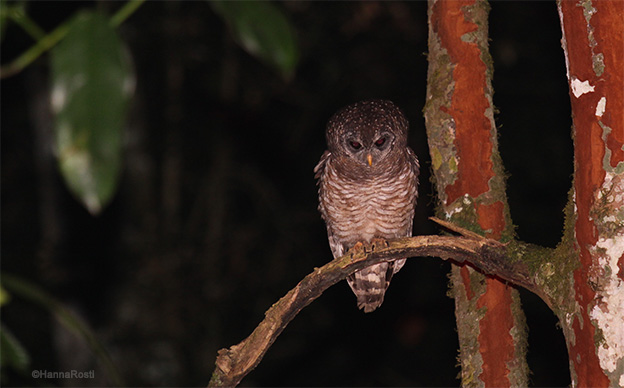
Afrikan metsäpöllö (Strix woodfordii) huhuilee vielä Taitan jäljellä olevissa metsissä. Afrikan metsäpöllö kuuluu siis sukuun Strix, johon kuuluu myös meidän viirupöllömme (Strix uralensis). Näillä pöllöillä ei ole korvatupsuja.
Afrikan metsäpöllö etsii pikkugalagoa joka juuri pakeni sen kynsistä. Taitavuoret 2019.
Pöllöpariskunnat pitävät yhteyttä toisiinsa huhuilemalla. Naaraan huhuiluissa on korkeampi taajuus, tai se voi käyttää kokonaan toista “huui” äännettä.
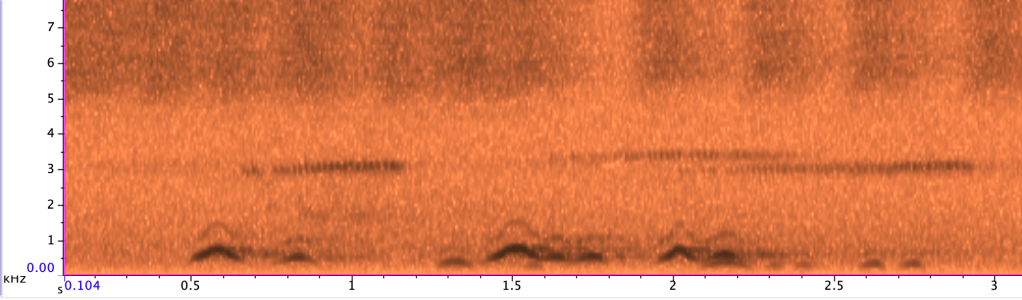
Afrikan metsäpöllöpariskunta. Naaraas huhuilee korkeammalla sävelellä. Spektrogrammi metsäpöllöjen huhuilusta. Pöllöt huhuilevat noin yhden kilohertsin taajuudella.
Afrikan metsäpöllöt elävät yhdessä ja pitävät yhteyttä toisiinsa ympärivuotisesti, ainakin Taitavuorilla.
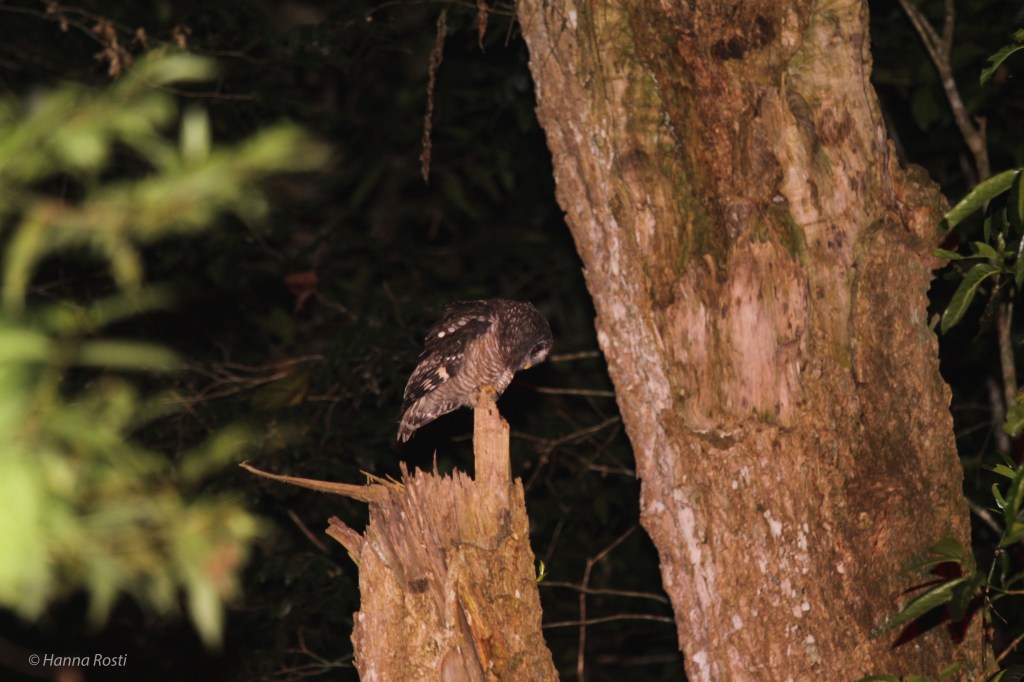
Afrikan metsäpöllö katselee maahan, josta se saalistaa hyönteisiä.
Afrikan metsäpöllö on noin variksen kokoinen 30-35 cm pitkä ja painaa noin 240-350 grammaa. Se syö eniten hyönteisiä, mutta saalistaa toki mahdollisuuksien mukaan myös pieniä nisäkkäitä.
Ainakaan nämä pöllöt eivät näe punaista valoa, eivätkä ne kiinnittäneet mitään huomiota ihmisiin, jotka ovat öisessä metsässä.
Afrikan metsäpöllö tyypillisessä saalistusasennossaan. Se on ruumiiltaan varsin tanakka.
Esiintyminen ja suojelutilanne
Afrikassa metsäpöllö on edelleen yleinen. Sitä tavataan varsin suuressa osassa Afrikkaa. Kansainvälisen luonnonsuojeluliiton (IUCN) uhanalaisuusstatus on elinvoimainen (LC Least consern).
Tästä lajista ei ole kuitenkaan olemassa yhtään pidempiaikaista tutkimusta. Koska metsiä häviää eri puolilla Afrikkaa, on myös tämän lajin elinympäristöjen pieneneminen tosiasia.
Afrikan metsäpöllöltä tunnistetaan neljä alalajia. Nämä alalajit poikkeavat toisistaan ulkonäöltä huomattavasti
Strix woodfordii woodfordii: eteläisestä Angolasta Kongon Demokraattisen tasavallan eteläosiin, lounaisesta Tansaniasta, Botswanaan, ja Etelä-Afrikkaan.
Strix woodfordii nuchalis: Senegal, Gambia ja Biokon saari, eteläinen Sudan, Uganda, Kongon Demokraattisen tasavallan länsiosat, ja pohjoinen Angola
Strix woodfordii umbrina: Etiopia ja Sudan.
Strix woodfordii nigricantior: Eteläisestä Somaliasta to Keniaan, Tansaniaan, Zanzibarin saarelle, ja Kongon Demokraattisen tasavallan itäosat.
Takaapäin väritys on kauniin ruskea
Taksonomia
Linnaeus loi suvun Strix 1758 korvattomille pöllöille, suomeksi viirupöllöille. Strix suvun pöllöillä ei ole korvatupsuja. Maailmassa on 16-22 lajia näitä Strix suvun pöllöjä lähteistä riippuen ja niitä elää miltei joka puolella maailmaa.
Tässä suomalainen viirupöllö (Strix uralensis) jonka isäni oli löytänyt kuolleena joskus 1970 luvun alussa.Afrikan metsäpöllö raapimassa korvaansa. Taita Hills 2019.
African wood owl looking for Taita mountain dwarf galago, that just escaped from him.
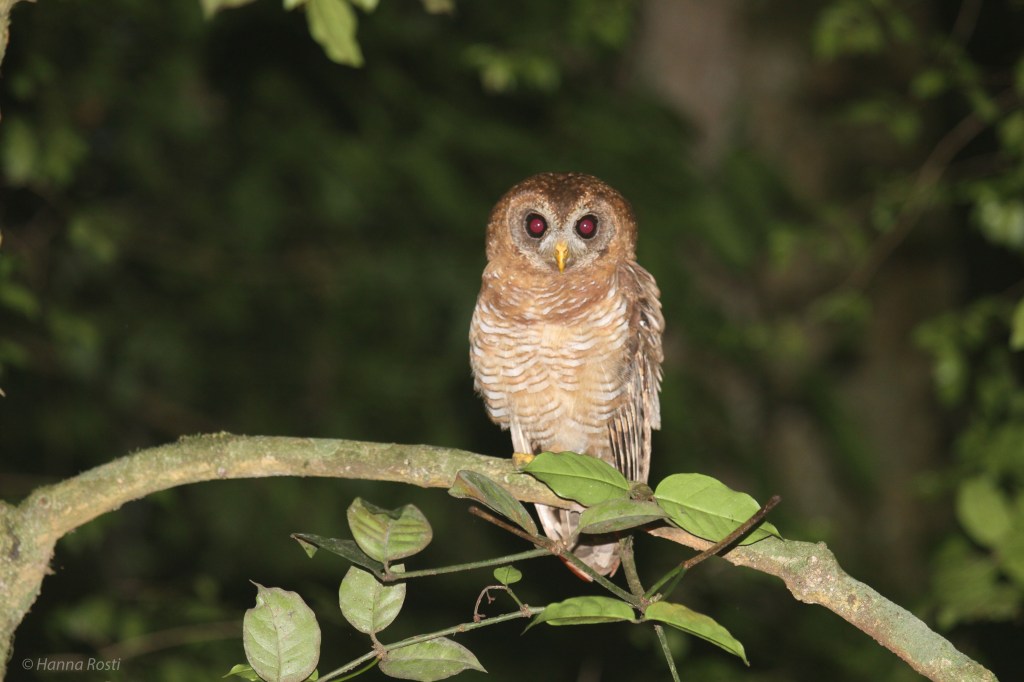
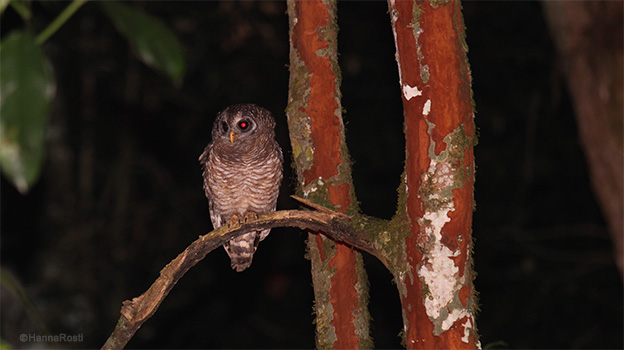
In Taita Hills of Kenya African wood owl (Strix woodfordii) is quite common. Owl couple keep contact with each other by calling. Interestingly male and female can counter call with similar calls, or female may use different call.
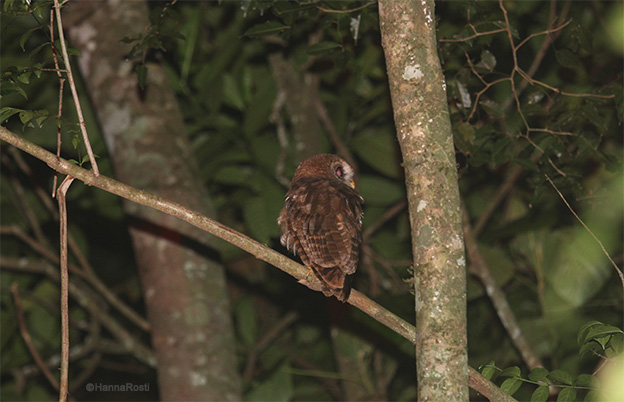
African wood owl from Ngangao Forest Taita Hills in 2019.
Counter calling of African wood owl couple from Taita Hills.
African wood owl male and female counter calling
Male makes a series of rapid, clear hoots, and the female answers with higher pitched, more leisurely hoots.
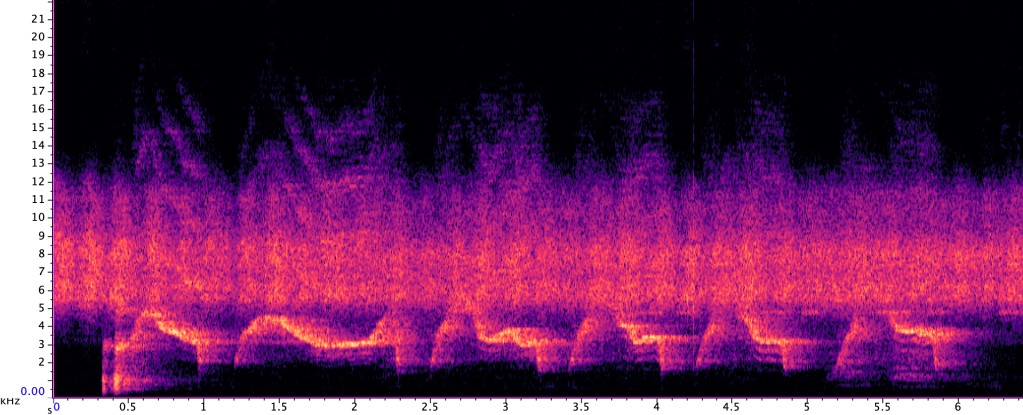
This is spectrogram of the part of calling sequence above made with Raven 1.6 Pro. On vertical axel you can see frequency and on horizontal axel the time. African wood owl hoots have fundamental (lowest) harmonic (lowest line) bellow 1 kHz. Calls coming near the recorder have stronger spectrogram. Above African wood owl there is another bird? with long chirr, and above that there are cicadas. So owls and cicadas can be easily heard simultaneously, as they use different frequencies.
Different call of a female African wood owl from Taita Hills
Hoot of a African wood owl female with nice lowering pitchSpectrogram of a female African wood owl, a single hoof with slight rise in the middle. Given also as a response to call above. Call is using frequency about one kHz. Black belt between 5-12 kHz are cicada choir.
African wood owls in Taita Hills are about the size of the crow, 30-35 cm, weighing 240-350 grams. African wood owl eats mainly insects.
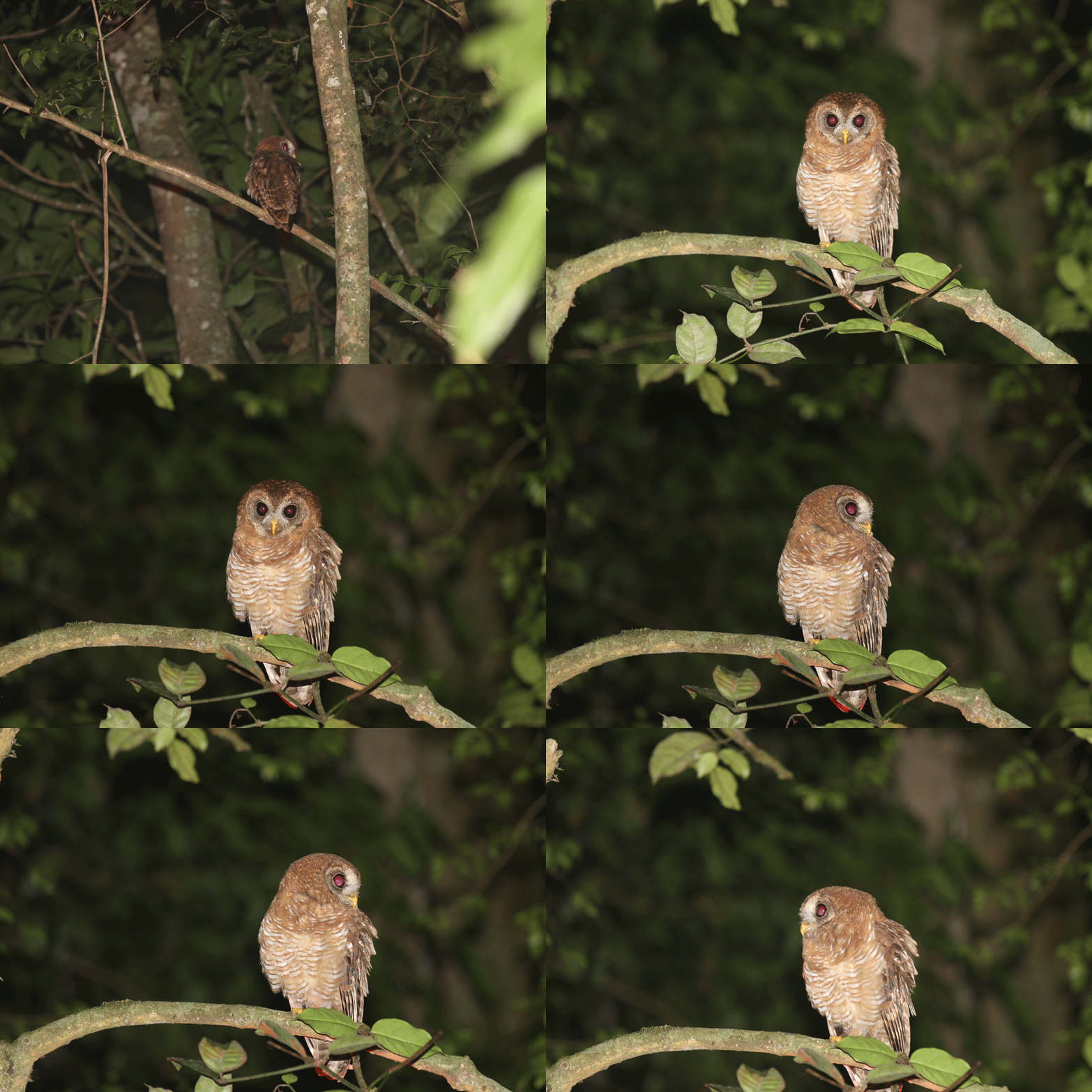
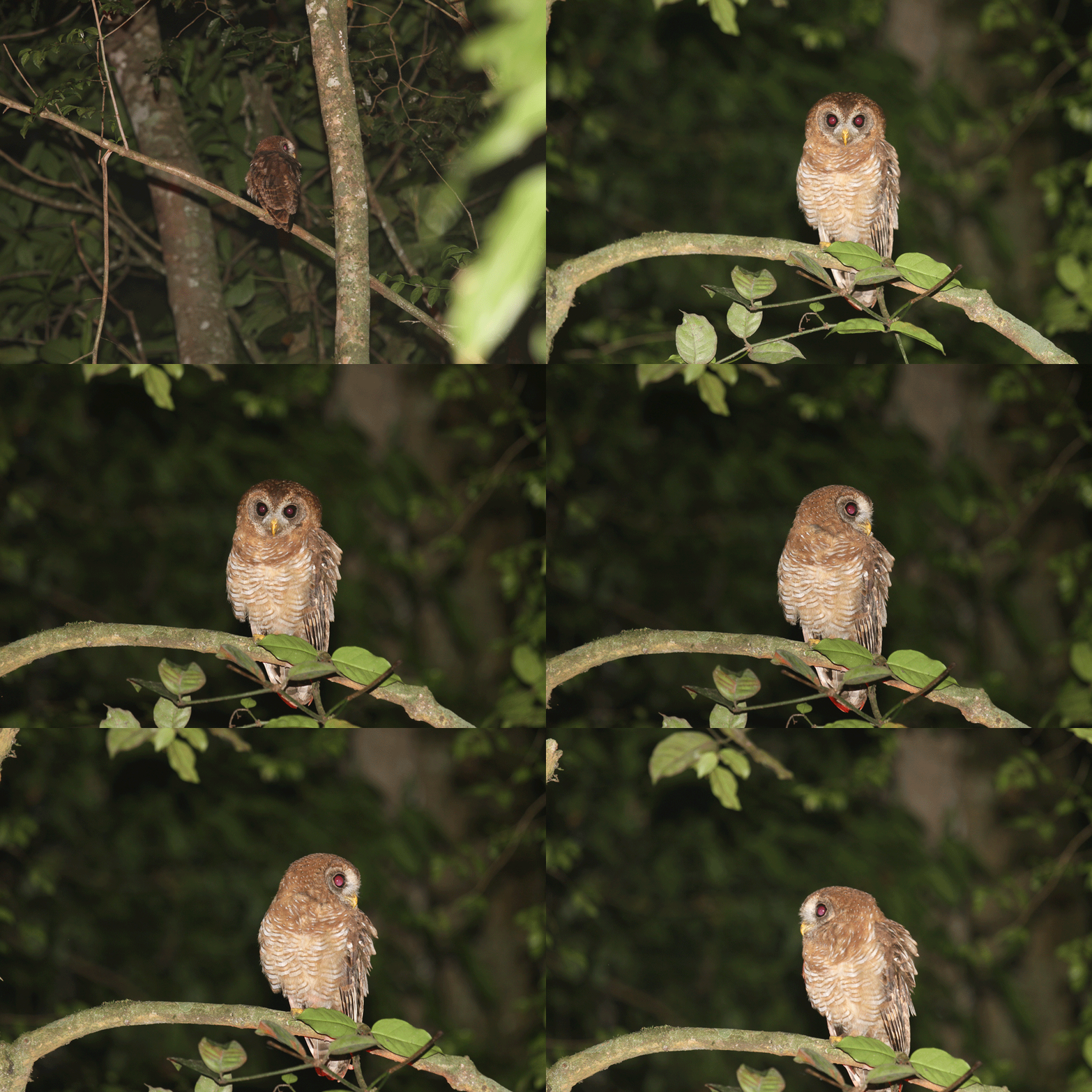
African wood owl looking for prey. Taita Hills 2019.
They can’t see red flashlight, which has enabled me to watch them without them without owls paying any attention for me.
African wood owl looking for insects or small mammals to prey on. Taita Hills 2019.
Mainly insectivorous, however they also catch small mammals… In Taita Hills African wood owls hunt also Taita mountain dwarf galagos that are almost extinct. For dwarf galagos this owl may be the ultimate reason for extinction.
From the behind coloring has beautiful shades of brown. Taita Hills 2019.
Reason for extremely low population numbers in dwarf galagos is loss of habitat, as forests have been cleared for fields. However, in these small remaining patches of forest, the probability of dwarf galago being hunted by wood owl increases. They share same territories every night. Dwarf galagos are dependent on refugee sites in hollow trees. Only very old trees are have hollows or are completely hollow.
Distribution and conservation status
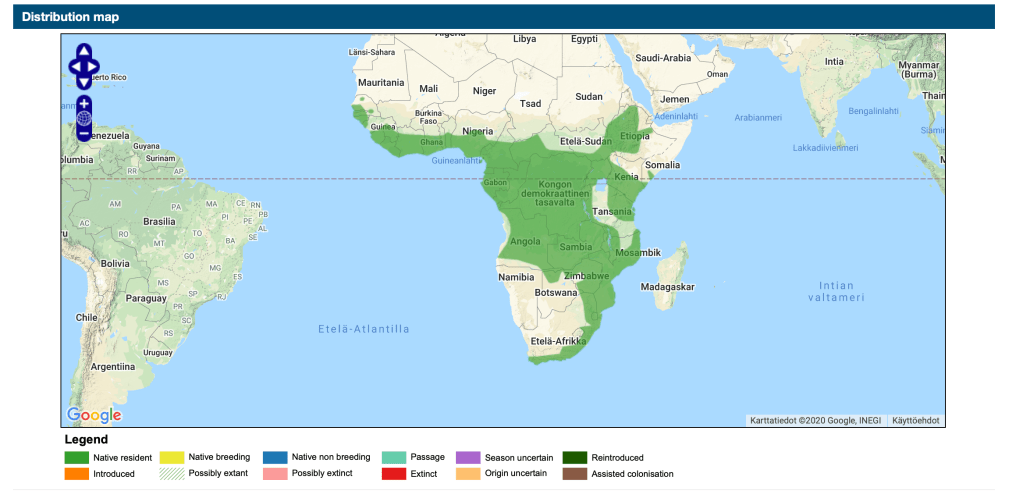
African wood owl has extremely large distribution in Africa. Conservation status is Least Concern LC. Populations seem to be stable. However there is no long term research about the species
Distribution map of African wood owl by BirdLife International. BirdLife International (2020) Species factsheet: Strix woodfordii. Downloaded from http://www.birdlife.org on 08/05/2020.
Geographic range from Avibase with four subspecies: These subspecies have considerable differences in their coloration.
Strix woodfordii woodfordii: southern Angola to southern Democratic Republic of the Congo, southwestern Tanzania, Botswana, and South Africa
Strix woodfordii nuchalis: Senegambia and Bioko Island to South Sudan, Uganda, western Democratic Republic of the Congo, and northern Angola
Strix woodfordii umbrina: Ethiopia and eastern South Sudan
Strix woodfordii nigricantior: southern Somalia to Kenya, Tanzania, Zanzibar, and eastern Democratic Republic of the Congo
African wood owl has horizontal stripes. Taita Hills 2019.
Taxonomy
Genus Strix was created by Linnaeus 1758 for earless owls. Strix owls do not have ear tufts. There are 22 species of genus Strix in the world. They are medium to large in size and live in forests. Strix owls are found around the world. African wood owl has four subspecies as described earlier.
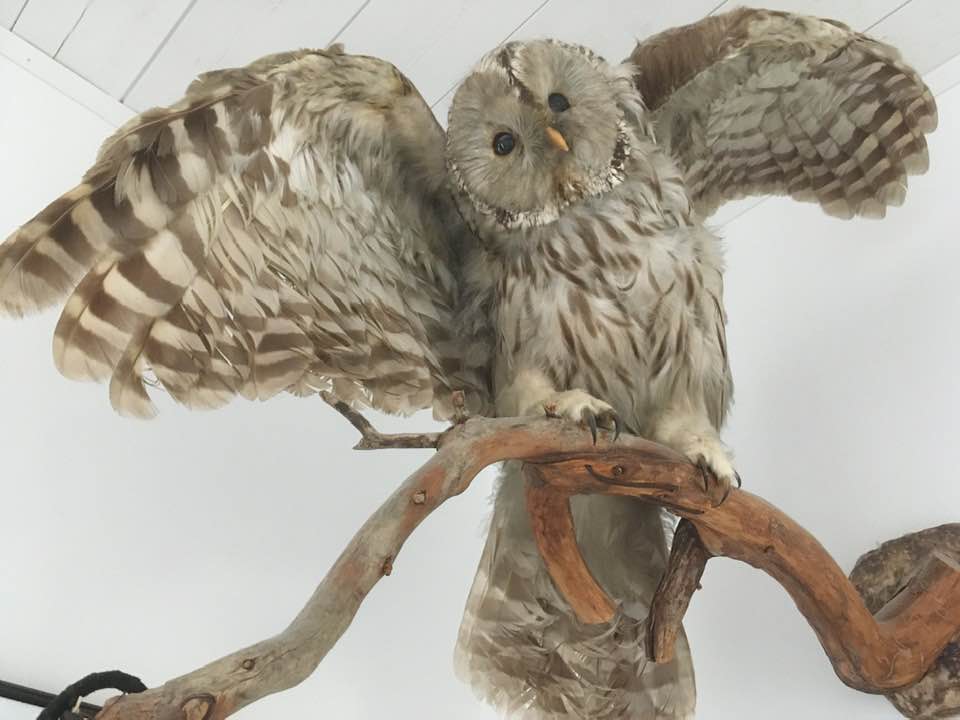
Here is Ural owl (Strix uralensis) from my home. This owl was found dead by my father in Finland 1970 and stuffed. Ural owl is much bigger than African wood owl. In Finland these owls are known for their strong protective behavior against people who put rings to baby owls feet.As an adaptation to cold climate the feet have feathers also.
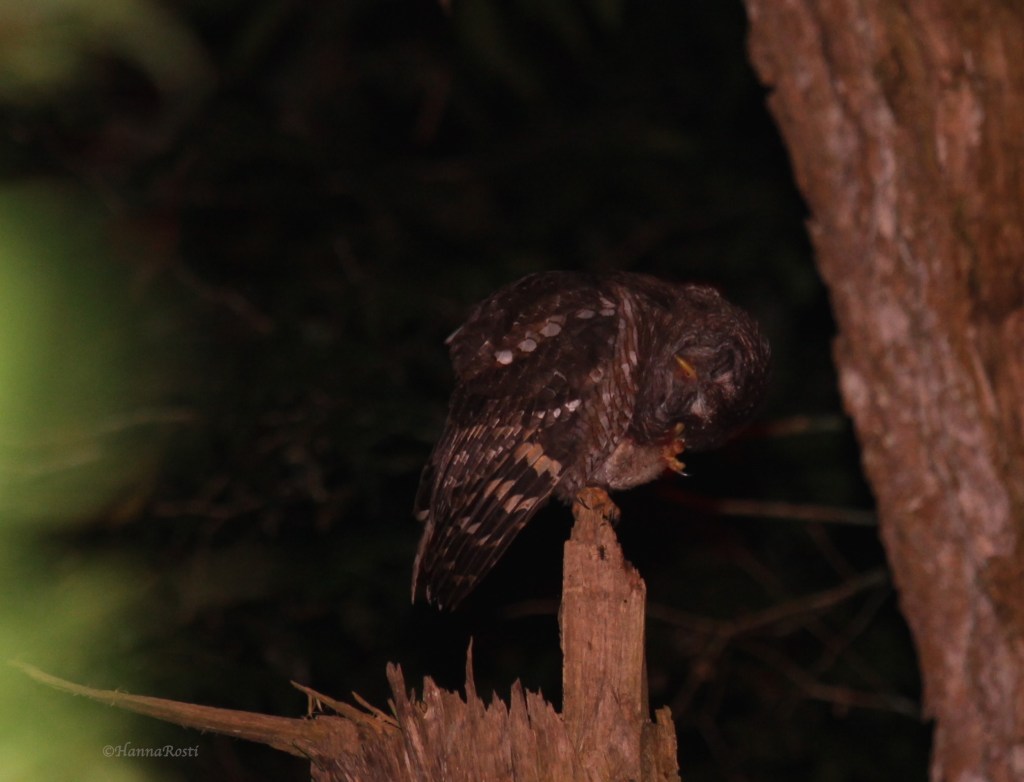
African wood owl scratching his ear. Taita Hills 2019.
I will never forget fist time that I heard tree hyrax. I was sitting on a log. It was first time I was in the forest after dark. I was companied by Kenya Forest Service ranger Jonam Mwandoe. Startling call, that seemed to come just to my ear, almost dropped me from the log. I asked what an earth was that?
Jonam told me about tree hyraxes, but I really didn’t understand. I had no idea that there could be relatives of elephants in the trees. For some time I thought of them as some peculiar rodents, which they really are not!
Each night in the forest had been filled with their vocalizations, where individuals counter call to another. But it took weeks to see one. At the time I had no idea how special this event was.
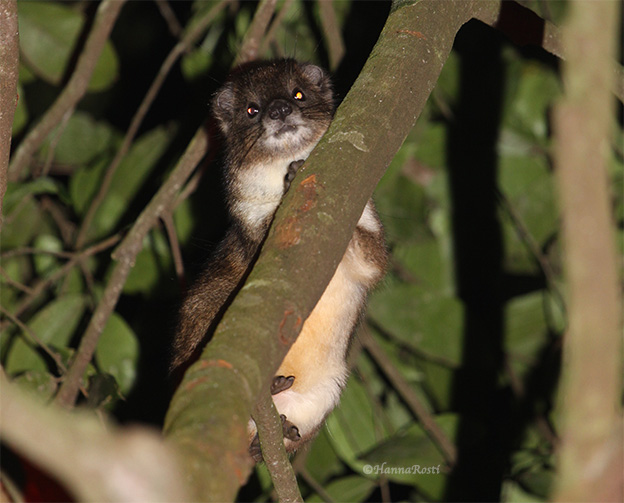
This individual, probably young female was first tree hyrax I saw. It was resting just about 4 meters above the ground. Females have smaller and rounder tusks.
Researchers just don’t see tree hyraxes. And this is probably why these animals are so neglected in science. Studying animals that you can’t see in difficult and challenging conditions and producing scientific articles with real data even more difficult.
As time went on I gathered more pictures and tons of recordings of their vocalizations. I became more and more intrigued by these mysterious animals. Then it really hit me:
Tree elephants!!!!
Hyraxes belong to Paenungulata, their relatives are elephants and manatees. How amazing and unbelievable group!
My supervisor, emeritus professor Simon Bearder pointed out from recordings, that these tree hyraxes are new species for the science.
Special features of tree hyraxes
Belong to Paenungulata with elephants and manatees
Small tusks
Teeth like rhinos
Dense fur
Three toes
Round body
Eat leaves, fibrous, low calorie diet
Slow metabolic rate
Complicated digestion system
Low body temperature
Internal testes
Whiskers around the body
Scent gland
Spends days in tree holes
Use toilets
Extremely variable vocal communication
Solitary
Nocturnal
Variable vocal communication suggests that this species has complex social behavior, even though they are solitary. Knowledge of these species and their behavior is very limited.
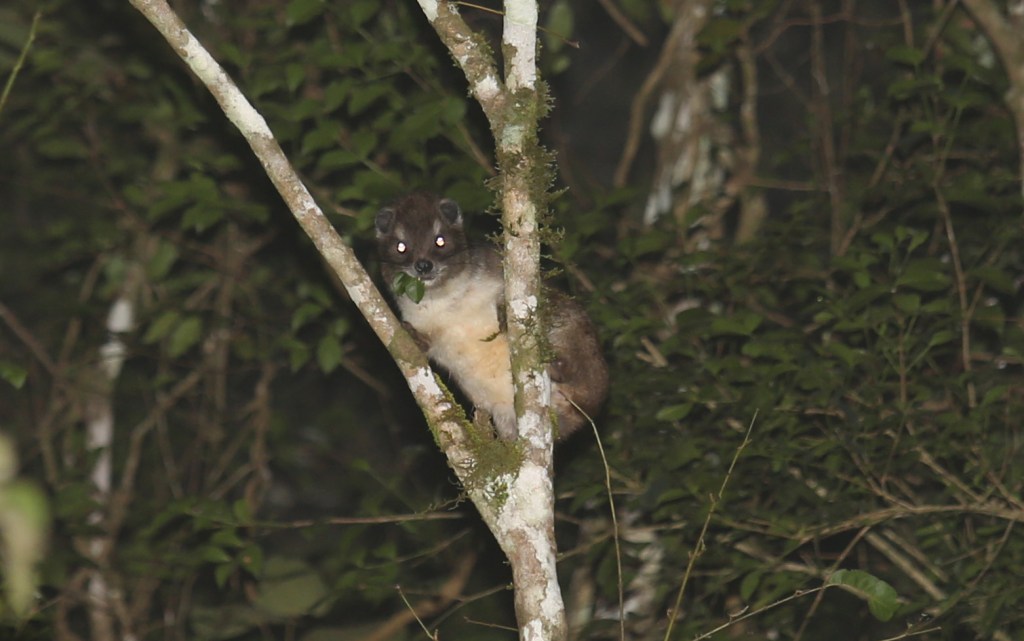
This male is much larger and has bigger tusks.
Ecological niche of tree hyrax is the same as koala and sloth
In some two largest forests of Taita Hills, Ngangao and Mbololo tree hyrax density is high. However total area of these forests are only three square kilometers. As density is high, young animals are forced to move out of forest, where they easy food for dogs.
Tree hyrax only lives in indigenous forest. It is dependent on tree cavities for safety
Tree hyrax jumping from branch to another. Thinking and hesitating took minutes before actual jump.
How tree hyraxes can live in the canopy of tall mountain rain forest is amazing. Animal is heavy, it has only tree toes. It seems like species that is taken out of their real environment.
One form of protection for this species could be to build artificial nest in areas, where are trees, but no tree cavities. However replanting of indigenous forest and building corridors between fragments is necessary for long term survival of this species.
This sweet female was observing us from close range, she was possibly moving on to new tree.
These unknown tree hyraxes are in serious threat by human development all over Africa, not just in Taita Hills. Different species of tree hyraxes are possibly going extinct even before they are identified.
Mammals of Africa (2013):
“Major revision of this group is overdue”
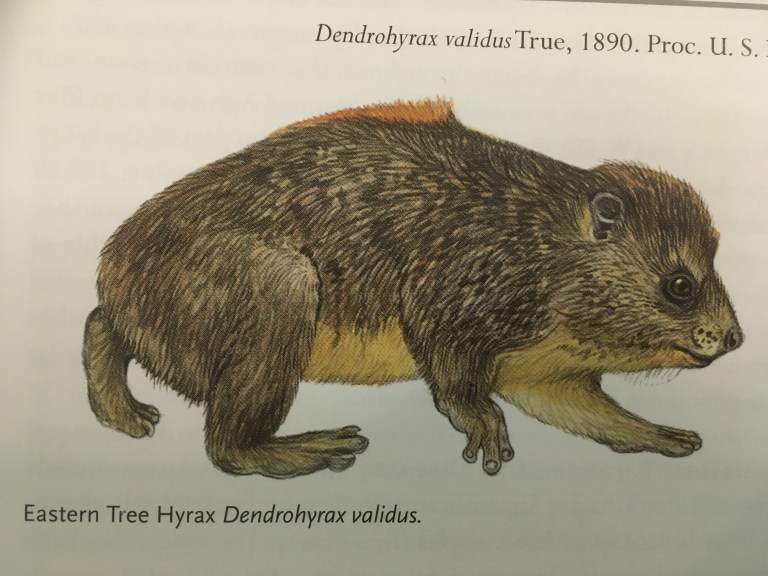
Eastern tree hyrax (Dendrohyrax validus) drawing from Mammals of Africa (Kingdon 2013).
“Taita tree hyrax desperately needs taxonomic identification and conservation”
Cordeiro, Norbert J., Nathalie Seddon, David R. Capper, Jonathan M. M. Ekstrom, Kim M. Howell, Isabel S. Isherwood, Charles A. M. Msuya, et al. 2005. “NOTES ON THE ECOLOGY AND STATUS OF SOME FOREST MAMMALS IN FOUR EASTERN ARC MOUNTAINS, TANZANIA.” Journal of East African Natural History 94 (1): 175–89. https://doi.org/10.2982/0012-8317(2005)94%5B175:NOTEAS%5D2.0.CO;2.
IUCN. 2013. “Dendrohyrax Arboreus: Butynski, T., Hoeck, H. & de Jong, Y.A.: The IUCN Red List of Threatened Species 2015: E.T6409A21282806.” International Union for Conservation of Nature. https://doi.org/10.2305/IUCN.UK.2015-2.RLTS.T6409A21282806.en.
IUCN. 2014. “Dendrohyrax Validus: Hoeck, H., Rovero, F., Cordeiro, N., Butynski, T., Perkin, A. & Jones, T.: The IUCN Red List of Threatened Species 2015: E.T136599A21288090.” International Union for Conservation of Nature. https://doi.org/10.2305/IUCN.UK.2015-2.RLTS.T136599A21288090.en.
Kingdon, Jonathan, ed. 2013. Mammals of Africa. Vol. 1: Introductory Chapters and Afrotheria. London: Bloomsbury.
Roberts, Diana. 2001. “GEOGRAPHIC VARIATION IN THE LOUDCALLS OF TREE HYRAX – DENDROHYRAX VALIDUS (TRUE 1890) – IN THE EASTERN ARC MOUNTAINS, EAST AFRICA: TAXONOMIC AND CONSERVATION IMPLICATIONS.” UNIVERSITY OF READING.
In Taita Hills there is small primate species that was first seen in 2002 and then no observations were made until 2018. In 2023 we failed to find it from Ngangao forest.
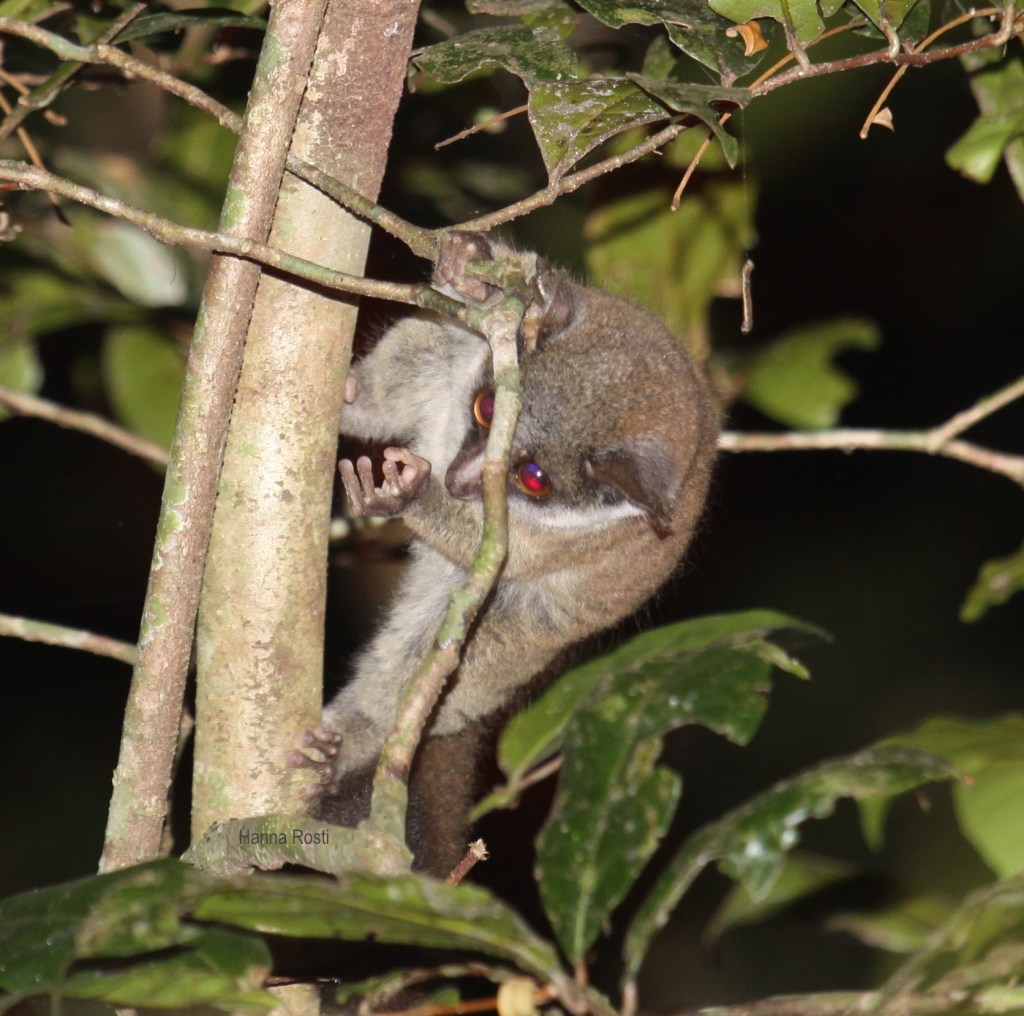
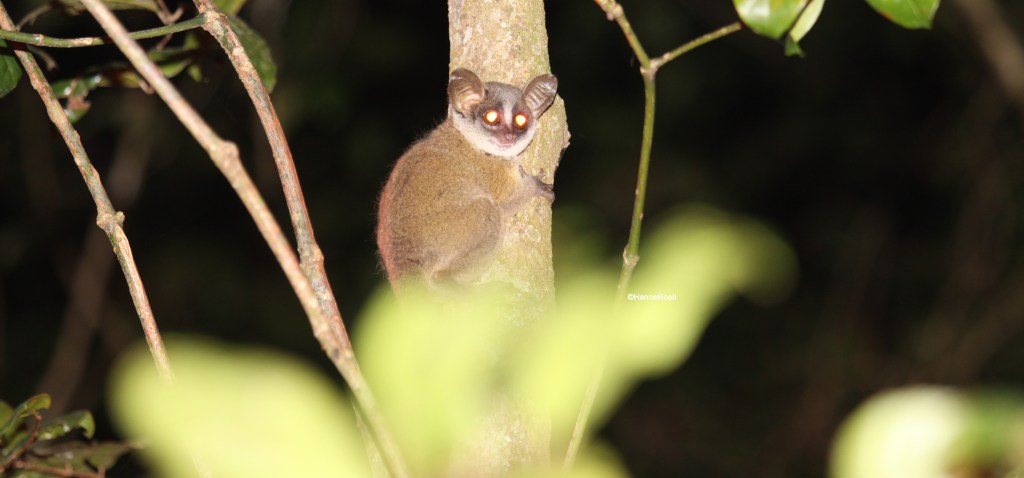
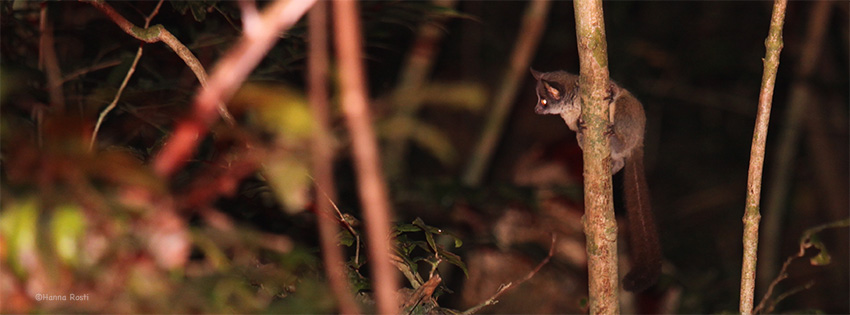
Dwarf galagos hunt insects by jumping from small tree to another like its relatives makis in Madagascar. Photo Rosti 2019.
This tiny -only 100-180 grams weighing dwarf galago eats insects in the hearts of most pristine parts of indigenous forests.
Oryx – the International Journal of Conservation published 11.2020 conservation news about Taita mountain dwarf galago: Taita mountain dwarf galago is extant in Taita Hills of Kenya https://doi.org/10.1017/S003060531900142X
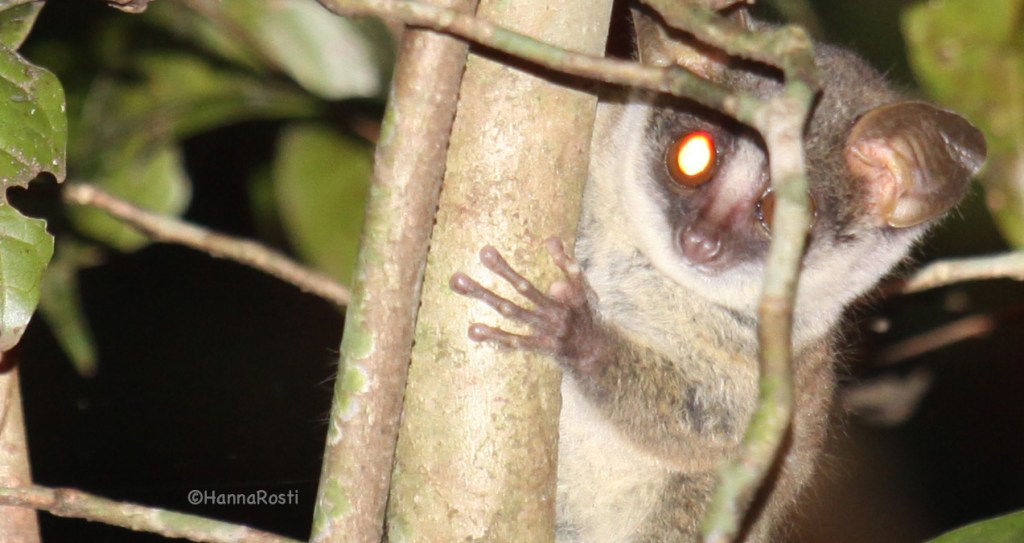
Cryptic dwarf galagos have intriguing hand morphology. Photo Rosti 2019.
Researcher from Nocturnal Primates Research Group identified calls of Taita mountain dwarf galago as Kenya Coast Dwarf Galago (Paragalago cocos). However these populations have been isolated for millions of years and live in completely different habitat. At the coast forest is low and temperatures high, in the mountains forest is high and temperatures low. All tree species are different between these forests. It seems that dwarf galagos in Taita Hills are relict population of once wider distribution of Kenya coast dwarf galagos.
Dwarf galago species are cryptic, meaning that they all look almost the same. Their vocal communication reveals the species, in the darkness of the forest, vocal communication is most important means of communication.
There is urgent need for conservation of forests and replanting of indigenous trees in Taita Hills.
Tree hyraxes of Taita Hills are new species for the science
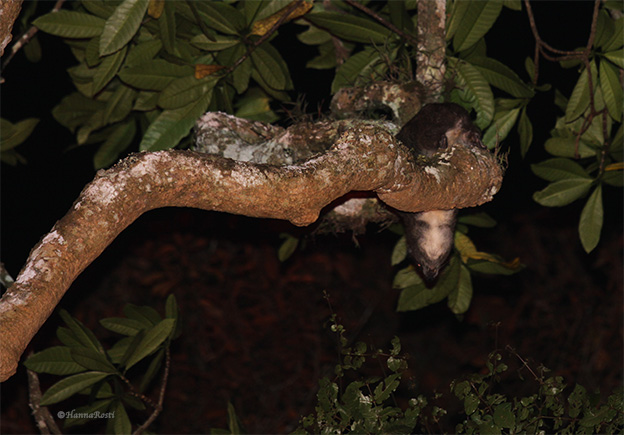
This is first picture ever taken from Taita tree hyrax. They are highly vocal, but difficult to find. Photo Rosti 2019
Tree hyraxes of Taita Hills should be conserved as Critically Endangered species
Both species are dependent of indigenous trees as their habitat. Dwarf galagos eat insects and tree hyraxes eat leaves of indigenous trees. Both are dependent on tree cavities for daytime shelter.
How these species were found
Mysterious cryptic dwarf galagos was mentioned first in article in Journal of East African Natural History 91: 1–13 (2002) by Andrew Perkin, Thomas Butynski, Simon Bearder, Bernard Agwanda and Benny Bytebier 2002. Nothing happened after the article and nobody knew if this species existed any more.
Taita Hills research station has been the base of the research. Director of research station and professor of Helsinki University Petri Pellikka has contributed enormously to this research even before the beginning.
Professor from University of Helsinki, Jouko Rikkinen told me about this species, as he had been intrigued by it and its survival for years. Professor Rikkinen has been studying biodiversity of Taita Hills since 2009. Knowledge and insights of Jouko Rikkinen has been backbone of this research.
In August 2018 I began searching for these small primates, as no-one knew about their fate. My assistant in the forest was and still is Benson Mwakachola. He has been reliable and supportive companion in sometimes challenging conditions.
After search for several nights, we got super lucky and tiny animal with reddish eyes were looking at us in just few meters away. This dwarf galago seemed interested about us. And we were so happy to see it.
Emeritus professor Simon Bearder from Oxford Brookes University has contributed in many ways as he is expert on nocturnal mammals and primatology. Simon had been one of writers of first article about Taita mountain dwarf galago in 2002.
From the recordings Simon Bearder, who has 40 years of experience from nocturnal animal research in Africa, understood that tree hyrax in Taita Hills is different species than it had been thought to be.
News in Daily Mail: Adorable 3.5OUNCE African primate the Taita mountain dwarf galago is caught on camera for the first time in nearly 20 years as the species faces extinction
Most people who see hyraxes in Kenya or in Africa in general think that they are some sort of rodents, as they look like overgrown guinea pigs.
It is amazing that closest relatives to hyraxes are elephants!
Furry coat protects from cold temperature. Hyraxes have low body temperature. They rely on sun bathing to lift their body temperature. Grasses that they eat, are low nutrient food and hyraxes have several adaptations to allow them to cope with such low nutrient diet.
These animals are actually related to elephants and manatees. They belong to the and cohort Paenungulata – where also elephants, manatees and dugongs belong (Mammals of Africa 2013).
Strange appearance has lead to misleading name hyrax, which means “shrew mouse”. In South Africa they are called “dassie”, that is derived from Dutch word for badger, equally misleading.
In Hebrew hyraxes were known as shaphan, “meaning the hidden one”. As sailors came 3000 years ago to coast of Spain, they named it I-shaphan-im -Island of the Hyrax. As they saw many animals that they believed to be hyraxes. Animals were actually rabbits.
So country Spain derives its name from misunderstanding, it is named after animals that have never been there. Hyraxes are endemic to Africa.
More than 25 million years ago, there where many more species and hyraxes where largest group of medium sized herbivores. Now there are only three geniuses left and these are living in harsh conditions where competition from other herbivores is minimal.
Three genera of hyraxes:
Procavia – rock hyraxes
Heterohyrax – bush hyraxes
Dendrohyrax – tree hyraxes
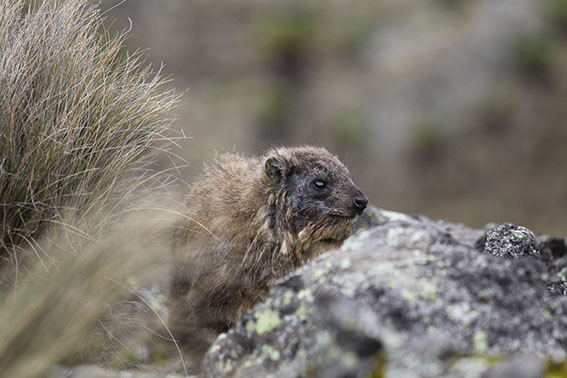
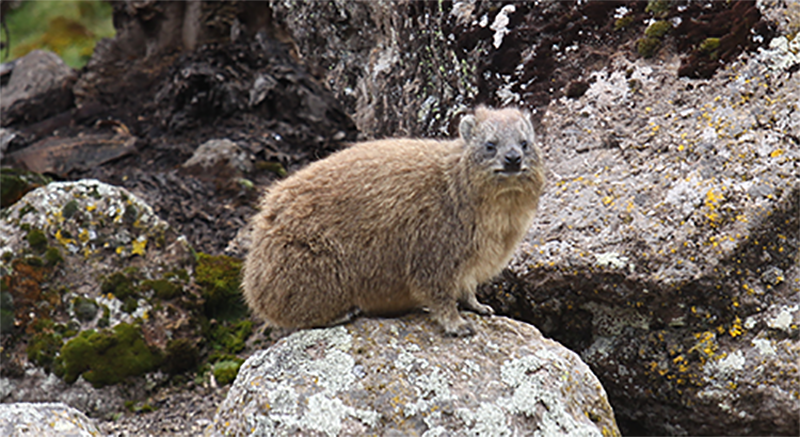
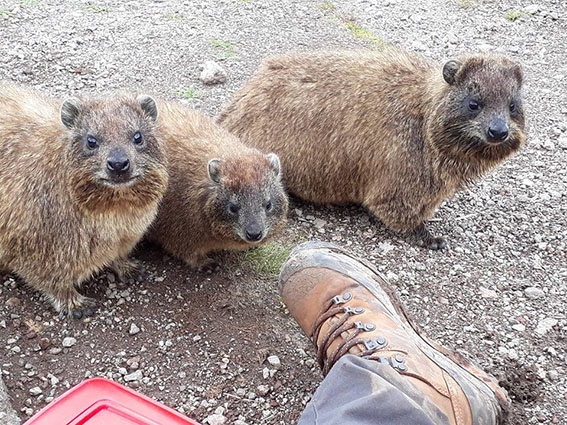
In Mt Kenya, and also in some other places, rock hyraxes are getting used to people and hang around in hope of food
Incredible features of hyraxes
Hyraxes have tree toes, these cute soft toes are sausage like. Teeth of hyraxes are weird for small animals, resembling rhinos or horses. Upper incisors are tusk-like, larger in males than in females (Hoeck). These tusks remind of their large distant relatives, elephants.
Hyraxes have low body temperature, and they use sunshine to rise their body temperature. Hyraxes conserve energy by having low body temperature, getting warm in the sun and resting a lot. They are dependent on cavities of rock or trees for shelter to stay warm. Hyraxes have internal testes, as lower body temperature allows testes to remain inside the body.
The eye of rock hyrax has shield called “umbraculum” that allows them to stare at the sun. Perhaps this adaptation allows them to see attacks of eagles, as animals are exposed when they are basking in the sun.
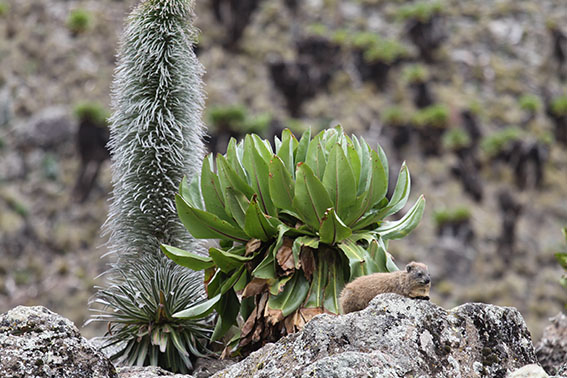
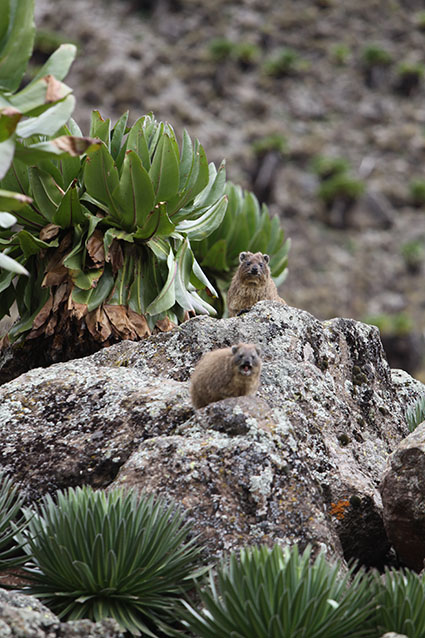
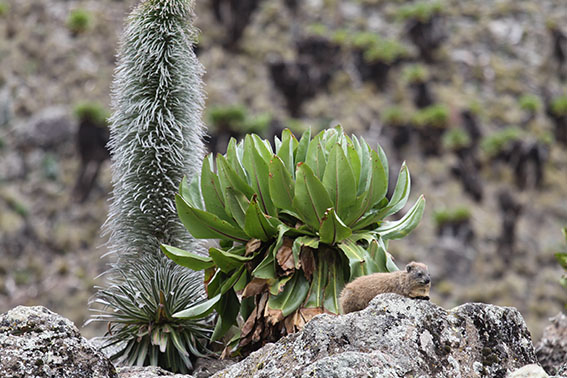
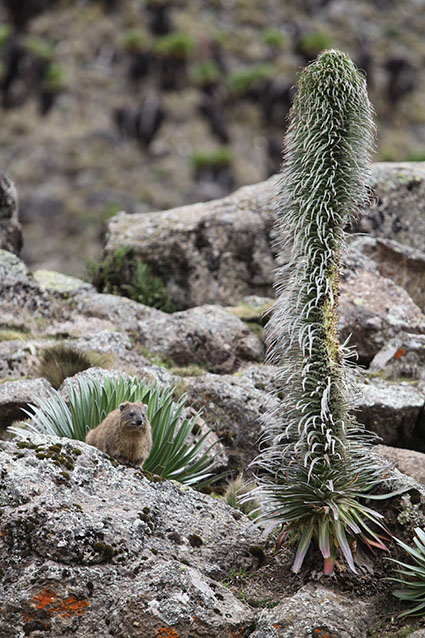
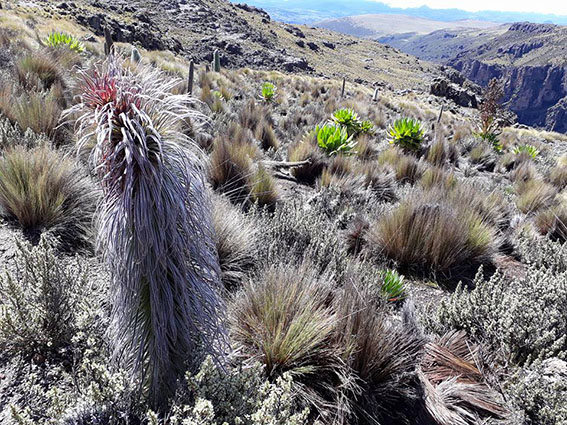
In Mt Kenya Senecio plant (in front) and Giant lobelia (behind) are largest plants. Hyraxes are living on small grasses. Their slow metabolic rate and capability to gather heat from the sun, allows them to live in such hard conditions.
Rock hyrax eats grasses. Hyraxes do not ruminate, but their ability to digest fibers is just as efficient. Morphology of digestive system is complex and unique to hyraxes. Efficient kidneys allow them to survive with minimal water intake.
Animal with cuts in the cheek. Grasses on the left are their diet in Mt Kenya.
Hyraxes have long vibrissae (tactile hairs) distributed around their bodies. Probably helping them to orient in rock holes or in the darkness of the forest canopy, with tree hyraxes.
Rock hyraxes are diurnal, group living animals. Main communication method for rock hyraxes is vocal communication. Complex vocal communication include songs that male sing to attract mates (Koren & Geffren 2009).
Sources and additional reading:
Demartsev, Vlad, Arik Kershenbaum, Amiyaal Ilany, Adi Barocas, Einat Bar Ziv, Lee Koren, and Eli Geffen. 2014. “Male Hyraxes Increase Song Complexity and Duration in the Presence of Alert Individuals.” Behavioral Ecology 25 (6): 1451–58. https://doi.org/10.1093/beheco/aru155.
Ilany, Amiyaal, Adi Barocas, Michael Kam, Tchia Ilany, and Eli Geffen. 2013. “The Energy Cost of Singing in Wild Rock Hyrax Males: Evidence for an Index Signal.” Animal Behaviour 85 (5): 995–1001. https://doi.org/10.1016/j.anbehav.2013.02.023.
Kershenbaum, Arik, Amiyaal Ilany, Leon Blaustein, and Eli Geffen. 2012. “Syntactic Structure and Geographical Dialects in the Songs of Male Rock Hyraxes.” Proceedings of the Royal Society B: Biological Sciences 279 (1740): 2974–81. https://doi.org/10.1098/rspb.2012.0322.
Kingdon, Jonathan, ed. 2013. Mammals of Africa. Vol. 1: Introductory Chapters and Afrotheria. London: Bloomsbury.
Koren, Lee, and Eli Geffen. 2009. “Complex Call in Male Rock Hyrax (Procavia Capensis): A Multi-Information Distributing Channel.” Behavioral Ecology and Sociobiology 63 (4): 581–90. https://doi.org/10.1007/s00265-008-0693-2.
Weissman, Yishai A, Vlad Demartsev, Amiyaal Ilany, Adi Barocas, Einat Bar-Ziv, Inbar Shnitzer, Eli Geffen, and Lee Koren. 2019. “Acoustic Stability in Hyrax Snorts: Vocal Tightrope-Walkers or Wrathful Verbal Assailants?” Behavioral Ecology 30 (1): 223–30. https://doi.org/10.1093/beheco/ary141.
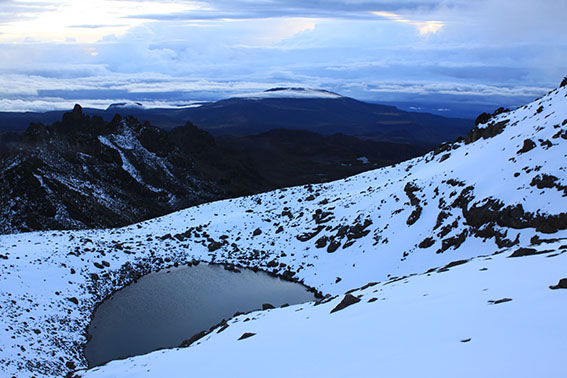
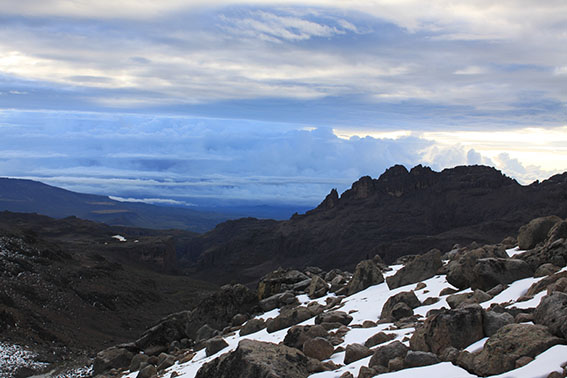
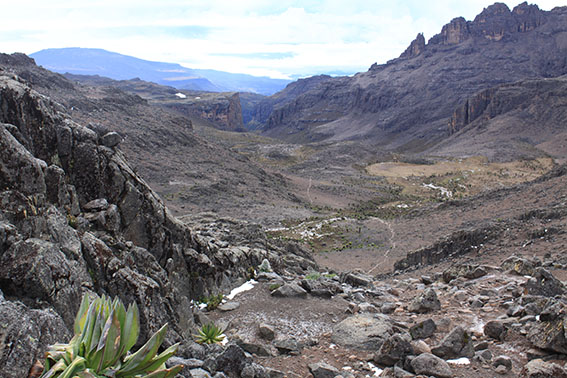
Mt Kenya is amazingly beautiful mountain with incredible plant fauna. There are several routes to choose from, so climber can ascend and descend from different directions.
I had always been fascinated by walking up the mountain, as you can basically walk from Equator to the North Pole, and see all different vegetation zones from forest to the glacier in few days.
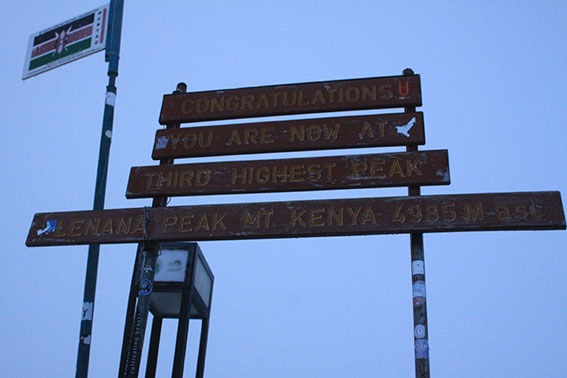
Highest peak, that can be reached without climbing gear is Point Lenana 4985 meters. This takes five days when leaving from Nairobi. It can be made faster, but this beautiful mountain deserves the time and you are less likely to have altitude issues.
I walked up the mountain using Sirimon and descended using Chogoria route. This is described as most beautiful route, and I can really verify that.
I climbed Mt Kenya in March 2018. It was during short rainy season. I was lucky, there was no rain when I was on the mountain.
I made my booking through Gracepatt Ecotours Kenya. I had my own two guides with me Martin and Charles.
I met few climbers in the huts, so I had company during evenings. But during the days I had the mountain for myself. It was special five day meditative experience.
Meals that are prepared in the mountain put whole new standard on camp cooking! For me, and for also other travelers chefs we’re preparing full meals with soup as appetizer, main course, and deserts. It was simply delicious. Food in Mt Kenya is excellent. I had no idea that such gorgeous meals can even be cooked in so simple and basic settings.
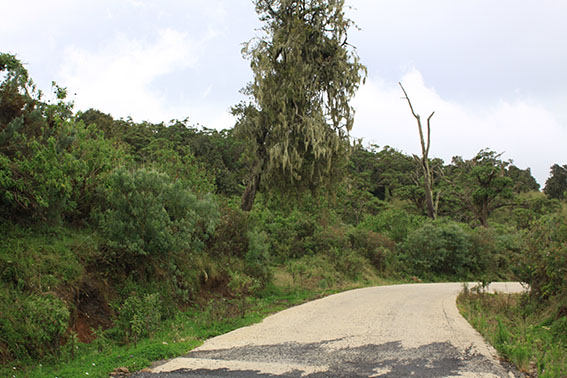
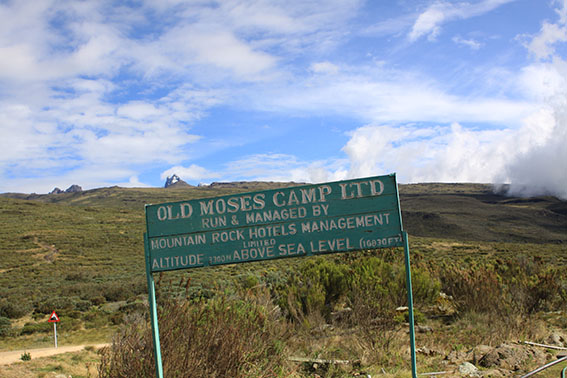
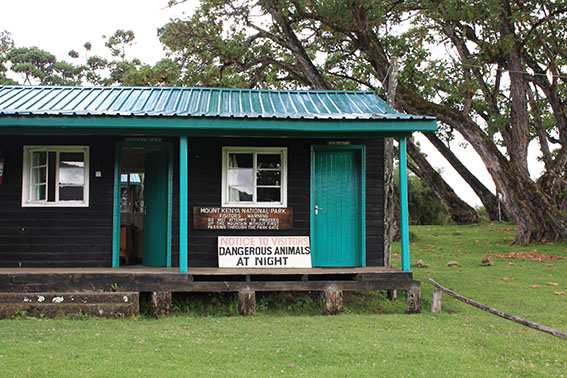
First day hike is by using tarmac road, that leads from Mt Kenya National Park Gate to Old Moses Camp. It is just about three hour hike.
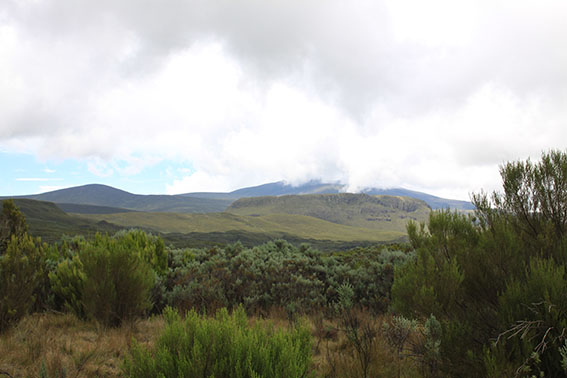
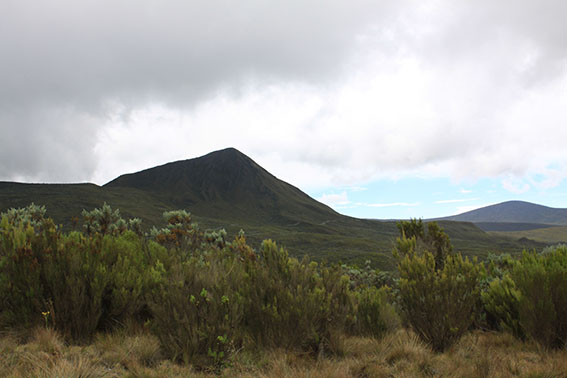
Walk begins with beautiful montane forest, continues in bamboo forest and changes again to giant heather.
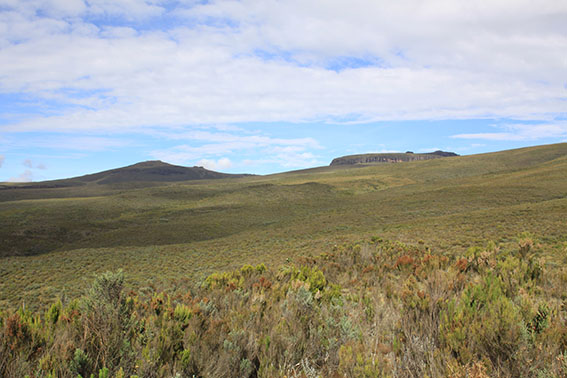
Photos from Tarmac road on the way to Old Moses Camp
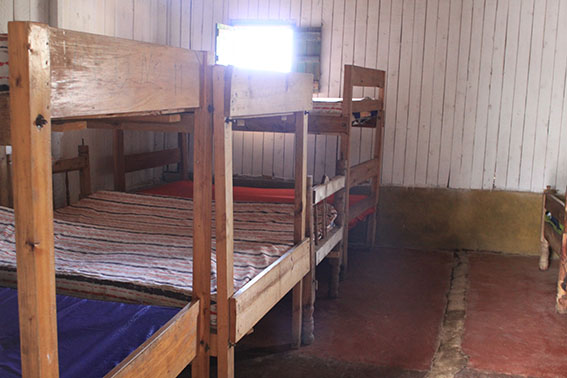
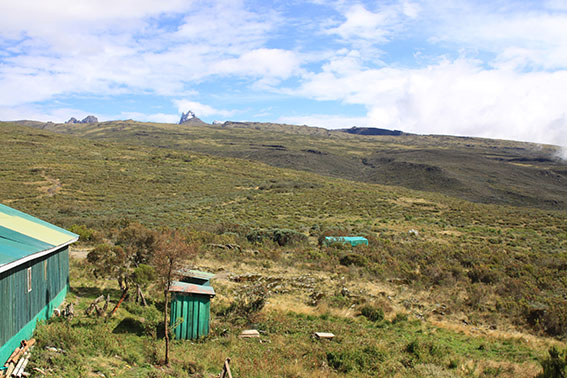
Photographs from Old Moses Camp, it almost looks like Scotland.
Old Moses Camp is basic camp with bunkbeds. There I met Mohammed from Jordania, who had just missed the peak as his guide had malaria fever episode, and he had to carry him down. Mohammed also gave me some tips how to adjust to make climb as easy as possible. Here they are:
As you reach your destination for the day, have a short brake, but then move on little more. Walk maybe 200-500 even further, stay there for half an hour and come back. It tells your body in advance what it has to prepare for.
Also, there is no electricity in the mountain. Using airplane mode in the phone saves battery. Mohammed actually gave more battery for me, as my phone was already going down on first day.
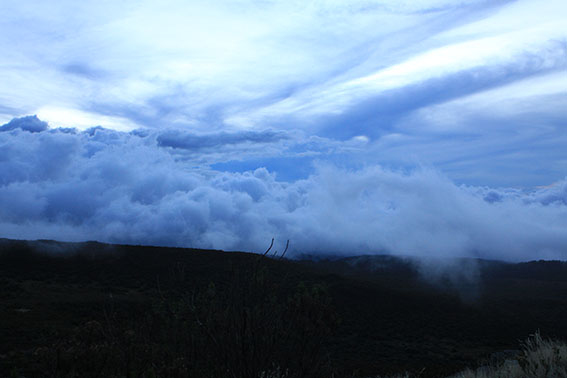
Old Moses camp is already above the clouds
Ascend to Shiptons camp is amazingly beautiful as vegetation in Mt Kenya is incredibly beautiful.
Endemic Giant Lobelia “ostrich plume plant” is only found from Mt Kenya. “Hairs” are needed for insulation to protect the flowers and the plant itself. Another strange looking plant is Senecio in the background.
Shipton Camp is basic camp to stay for additional day for adaptation to higher altitude.
In Shiptons Camp, and also elsewhere in the mountain there are groups of rock hyraxes (Procavia capensis). Hyraxes are incredible animals. Their closest relatives are elephants, they have three toes, internal testes, and teeth like rhinos. Hyrax communication is extremely variable and many climbers have been startled by their “ear splitting” screams, coming from just a meter away behind the rocks.
Having lunch with hyraxes. This time I had no idea, that later in life I would do PhD of tree hyraxes. There is whole post about hyraxes in Mt Kenya.
Rock hyrax, Senecio and Giant Lobelia.
I was there in March, during rainy season, there was no rain, however it was really cold. Temperature was close to zero during the day and bellow zero during the night. I mostly stayed in my winter sleeping bag. I was sitting in the sleeping bag during dinner. My guides were so cold they could not sleep.
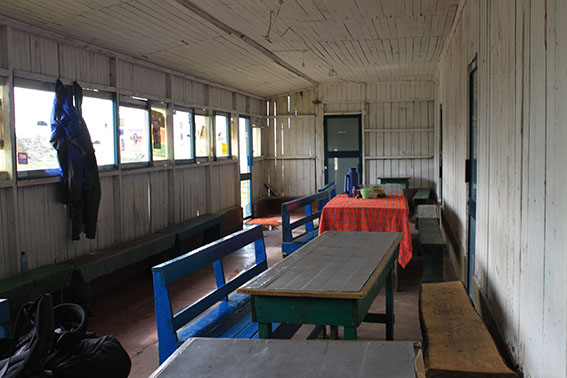
Shiptons Camp living room and view to Shiptons Camp from Point Lenana path.
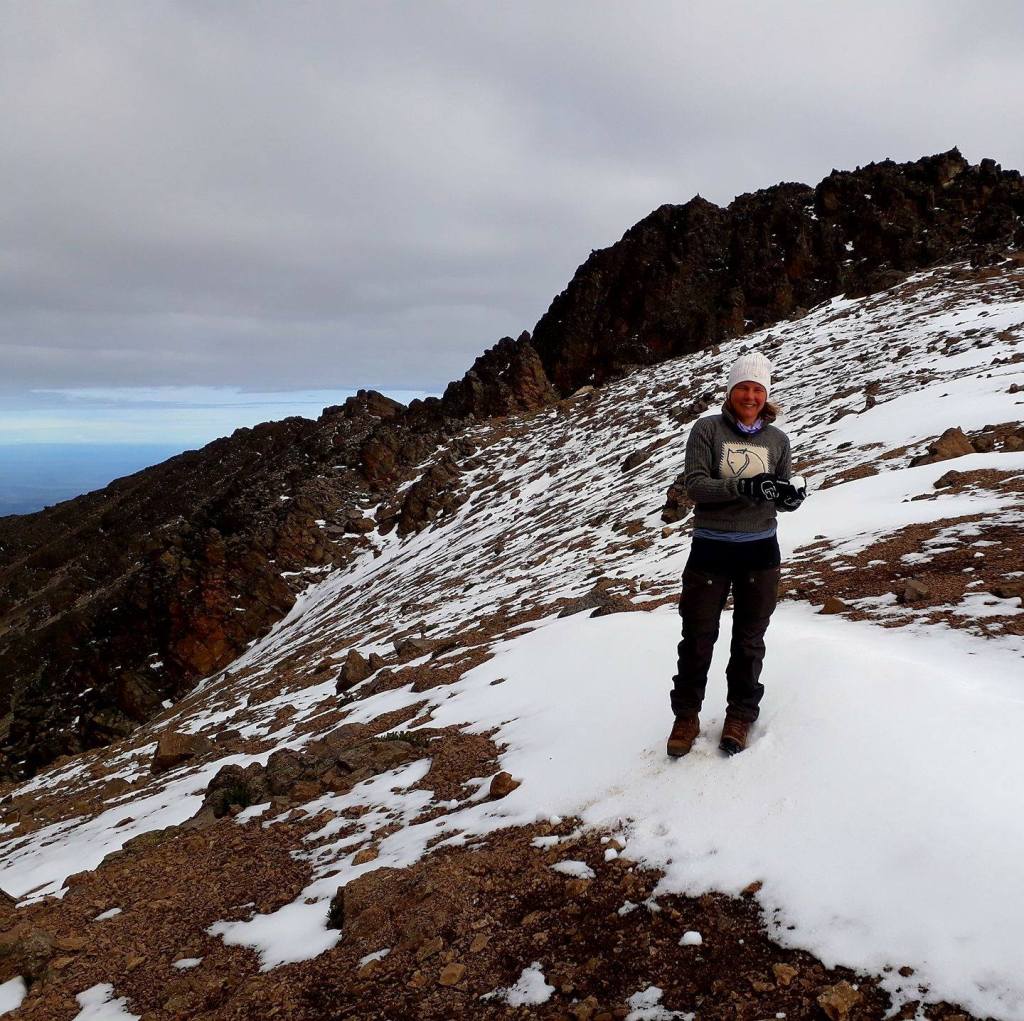
Ascent to Point Lenana takes few hours from Shiptons camp. Closer to the peak path becomes icy. At that point I wished I had taken my grips for shoes with me. One slip, and there would have been zero chance of survival.
As I was up in March, peak of Point Lenana was icy. Walking to the top was dangerous, as there was only ice, and nothing to hold on. One slip, and the fall would have been hundreds of meters. Simple spikes, the ones that can just be put on top of the shoe would have been great solution.
There were people who were not able to reach the top because of altitude symptoms. Some of them were very fit young men. I guess you can do best you can to help your body to adapt and then just hope it is enough. For me this was just a long walk, my body was just fine.
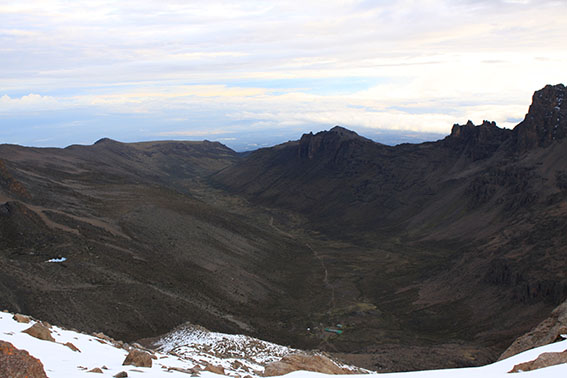
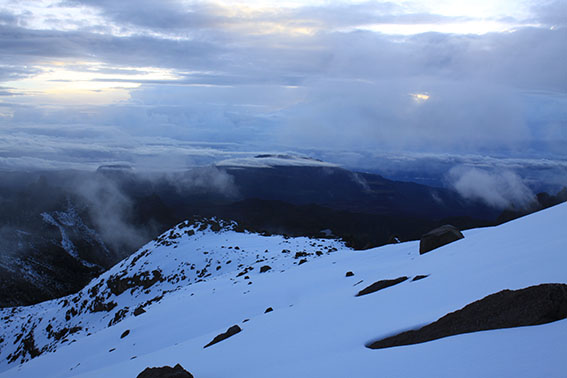
I was not lucky to see the sun set as it was cloudy. But when I began descending to the other side of the mountain clouds cleared and I had most beautiful walk of my entire life.
Going down from Point Lenana up to Mt Kenya Bandas is a long walk, about 28 kilometers. But as you are going down and view is all the time spectacular, it is a gorgeous day.
Animals from the way down
As day passes, scenery changes back to giant heather.
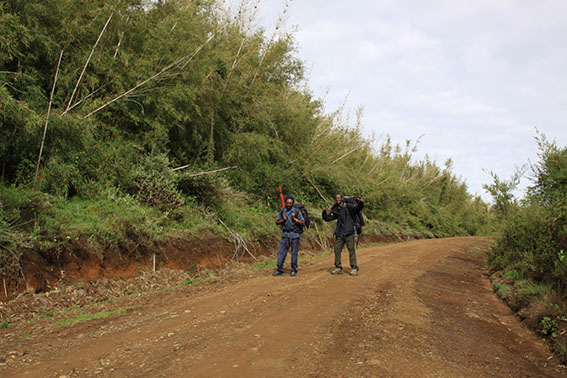
Then heather is behind and bamboo forest is around, and now you are back walking on the road that eventually leads to Mt Kenya Bandas.
My guide Charles and chef Martin Njure Kinyua. They took excellent care for me. They both enjoyed greatly their work going up and down Mt Kenya. It certainly would keep anyone lean and strong.
Mt Kenya bandas have very nice cabins and even hot shower! It is water warmed in barrel with wood.
Surroundings of Mt Kenya Bandas have a lot of wildlife, so keep your eyes open for sweet kudus.
Getting adapted to higher climate before heading up to the peak.
Mt Kasigau is one of Eastern Arc Mountains, belonging to world HOT SPOT areas of biodiversity. Indigenous forest that covers Mt Kasigau is amazing and mysterious remnant of forests that have been almost cleared.
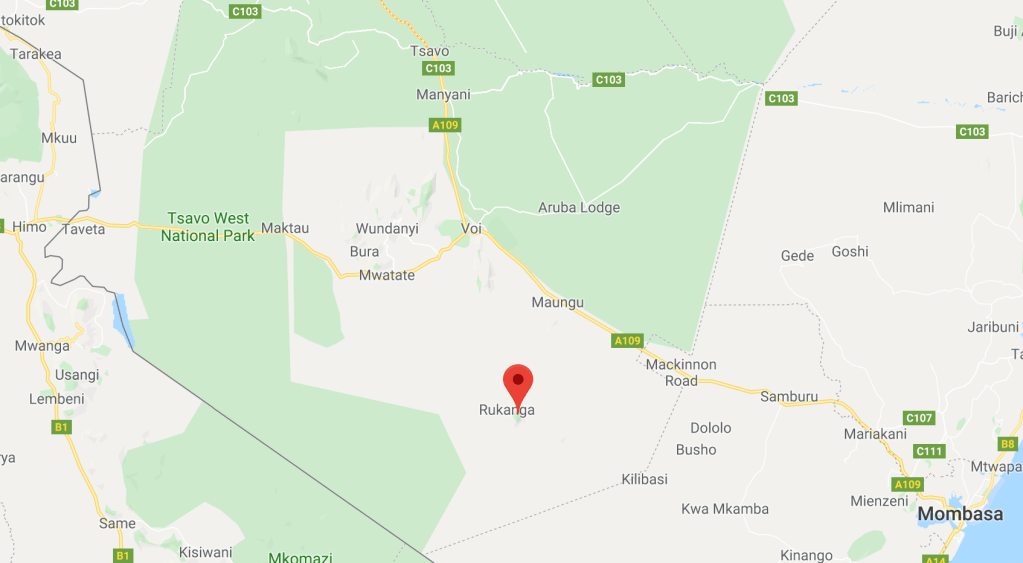
Mt Kasigau is located in Taita, about 45 min drive from Voi.
I have visited Mt Kasigau with plant biology course and later I came back to camp in Mt Kasigau Base Camp for three days. About 1600 meters high Mt Kasigau is easily walkable day-trip with good paths. It takes about 2,5 hours to reach the indigenous forest. It is strenuous hike under African sun with beautiful views. Wide path to follow begins close to Rukanga village and Mt Kasigau Base Camp.
Best time to walk up is in the morning. During the day lower part of the mountain, where is no shade by the forest is extremely hot.
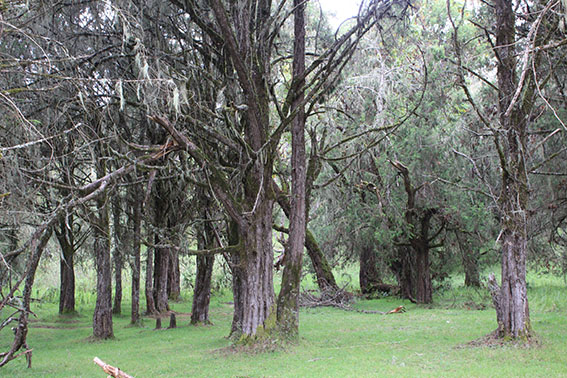
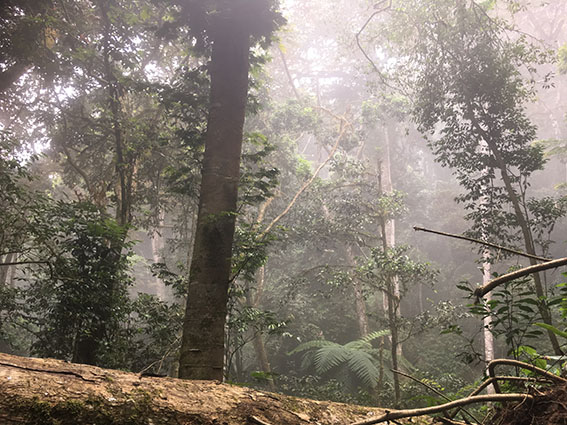
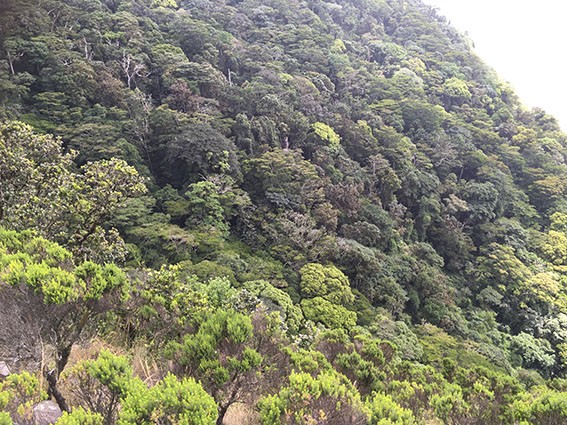
Indigenous forest is incredible mystical and beautiful.
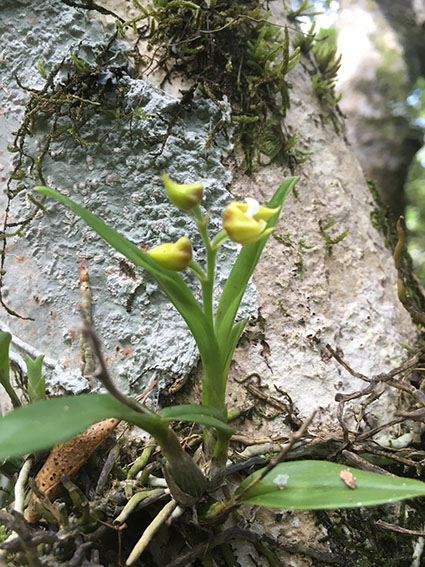
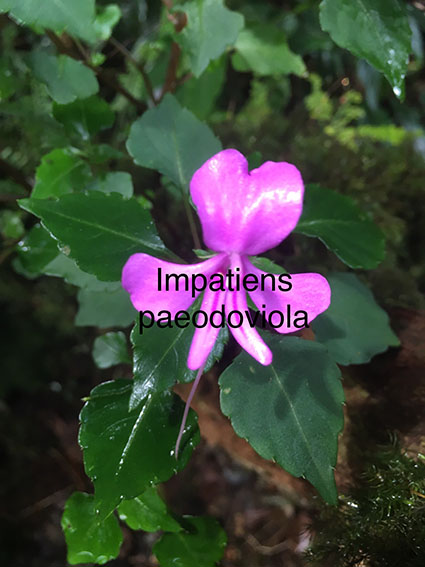
Forest of Mt Kasigau is incredibly diverse with endemic orchids and impatiens flowers.
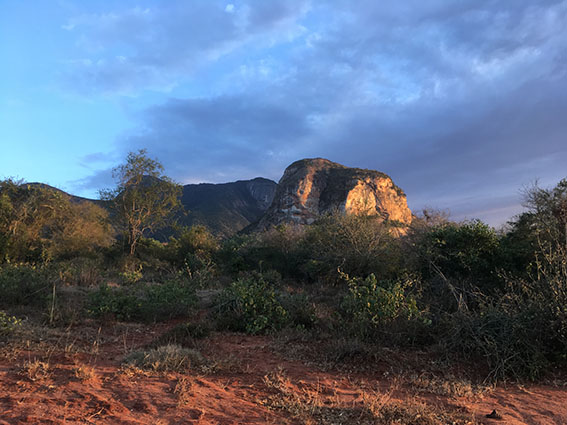
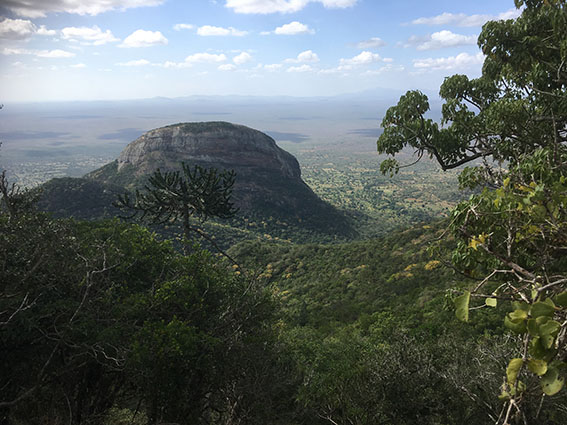
Views to Mt Kasigau and from Mt Kasigau are strikingly beautiful.
During WW1 German and Brittish troops were fighting in Mt Kasigau. There is memorial place on the mountain close to Jora village.
Memorial stone for soldiers who died in Mt Kasigau during WW1.
Mt Kasigau Base Camp has relaxing timeless atmosphere, and it is great place to stay when exploring Mt Kasigau and surroundings. Jackson, who works in Kasigau Base Camp can arrange everything. There are also climbing routes. I stayed in tent. I appreciate option to just close zipper and leave smaller animals outside.
Main kitchen area of Mt Kasigau base camp. There is no electricity, but it can be arranged from across the road. Skinny, mistreated dog is not from the camp, camp visitors are probably only ones that feed him occasionally.
I was there to look for nocturnal mammals. There was not much to be seen. I have discussed this with experienced researchers and conservationist. What we consider to be most likely reason, is that there was drier period sometime during the Pleistocene. This dry period was too much for some mammalian species, e.g dwarf galagos and tree hyraxes. As these species are poor to colonize new forest, they have not been able to return.
Some greater galagos (Otolemur garnettii) and rock hyrax live in Mt Kasiagau. I also heard that there is still one group of red colobus monkeys, but strikingly beautiful black colobus has been hunted until extinction.
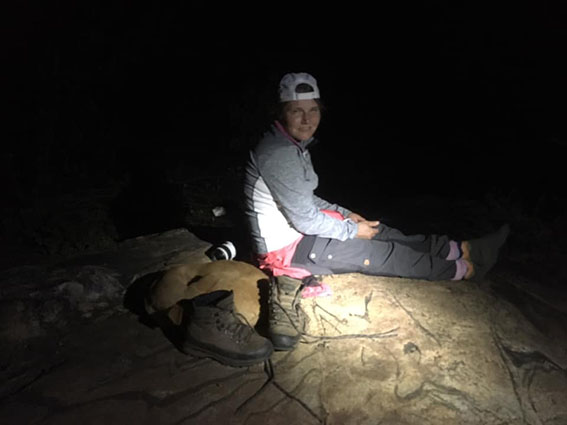
Large, dark, male greater galago in Mt Kasigau February 2019.Rechard Mwasi, me and Benson Mwakachola walking up from Jora, where path is much steeper in February 2019.Me and little dog taking a brake during the night February 2019.
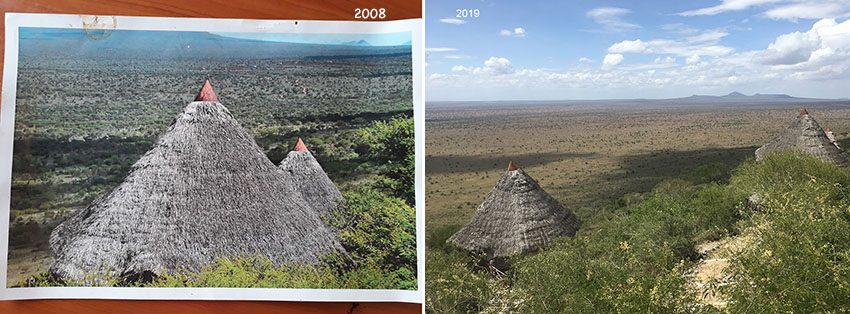
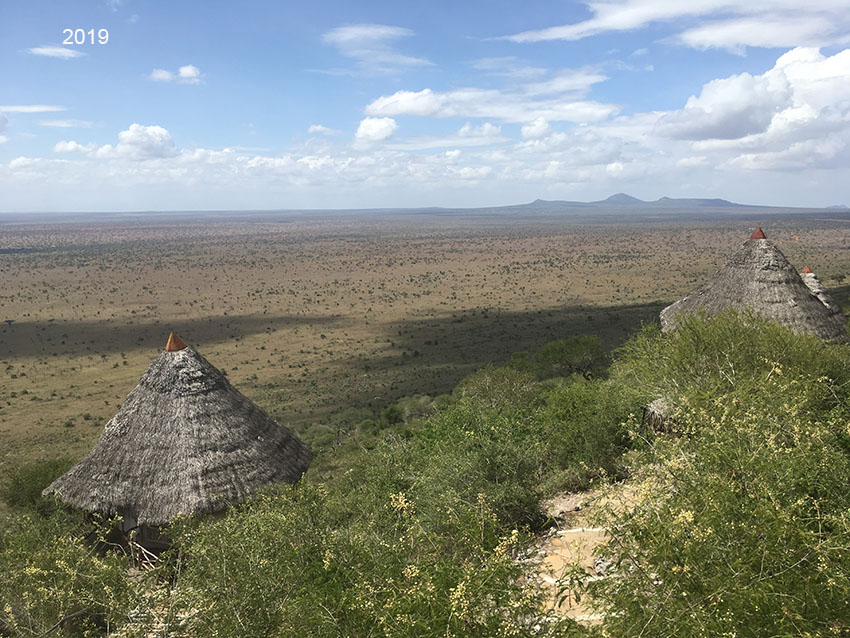
View to Lumo from Lions Bluff Hotel 2008 and 2019. Change in tree cover due to elephants is significant and leads to loss of biodiversity. Trees are habitats for many insects, birds need trees for nest sites and many herbivores are browsers during dry season.
Elephants in Tsavo and Lumo were severy poached, hunted for ivory for decades. Elephant poaching is less severe in many areas of Kenya at the moment, but it happens, as can be seen from orphan stories from Sheldric foundation. Drought and human wildlife conflict are also common reasons for baby elephant to be orphaned.
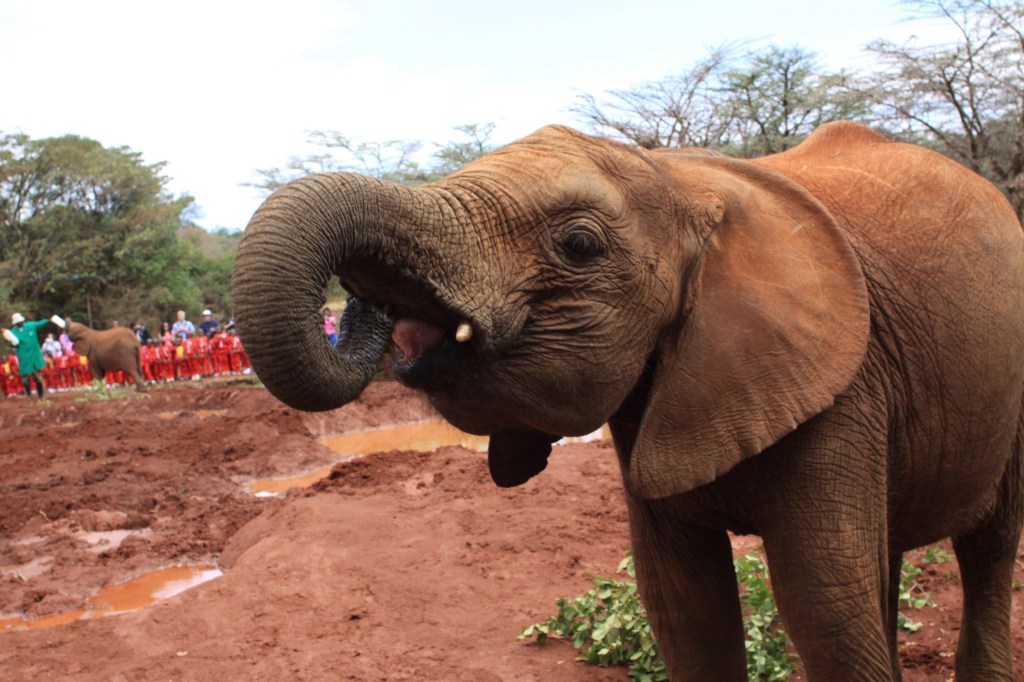
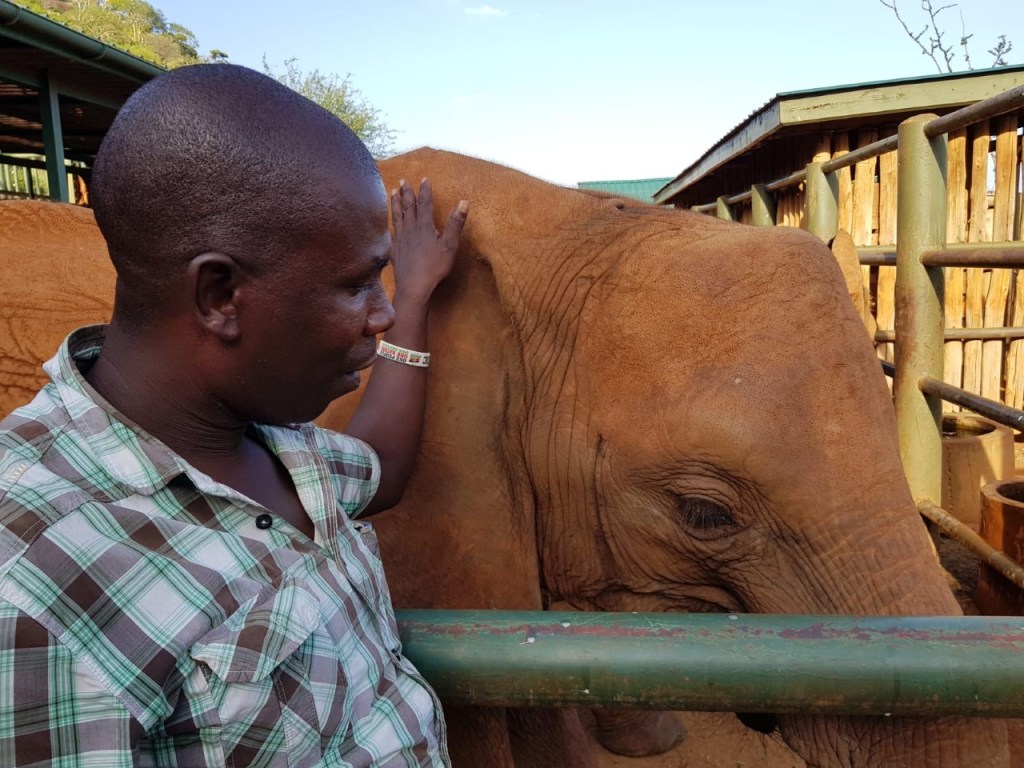
Baby orphan in Sheldrick elephant orphanage in Nairobi.
This article explains reasons behind worsening drought and human wildlife conflict in Taita area Kenya. What are consequences to the savanna, and also what could and should be done for protection of all species, humans, and local way of life.
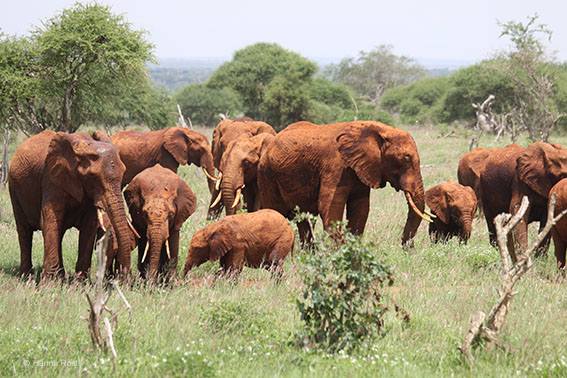
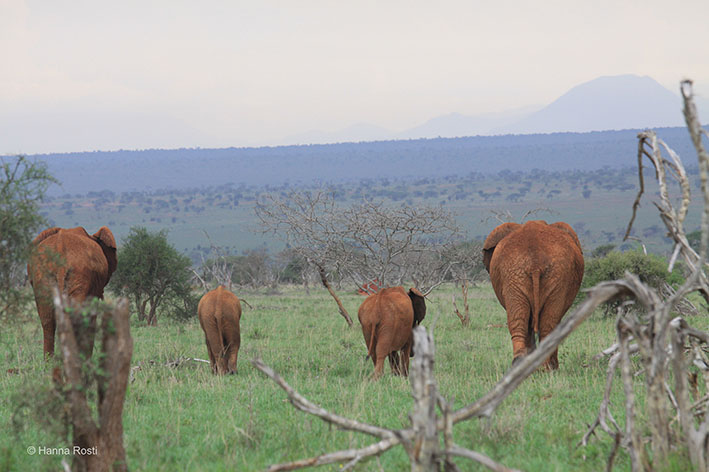
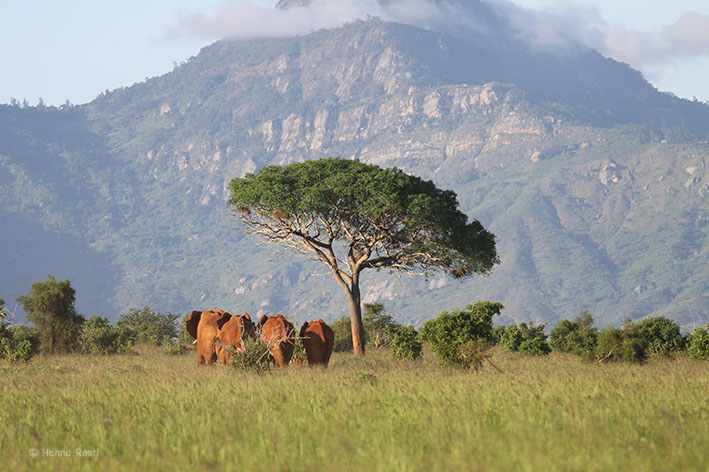
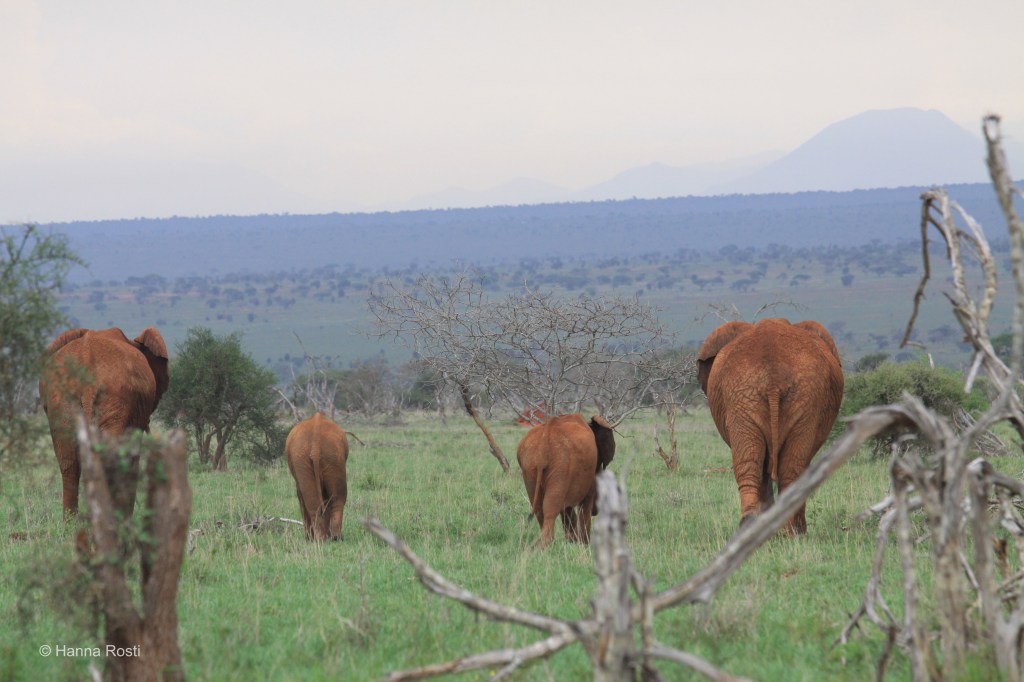
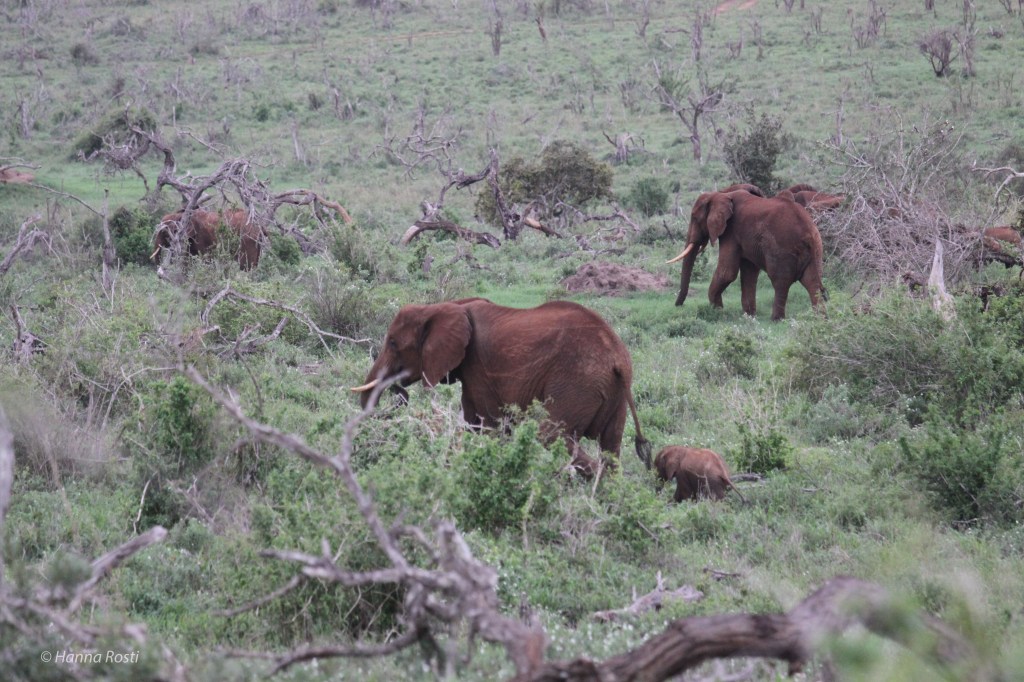
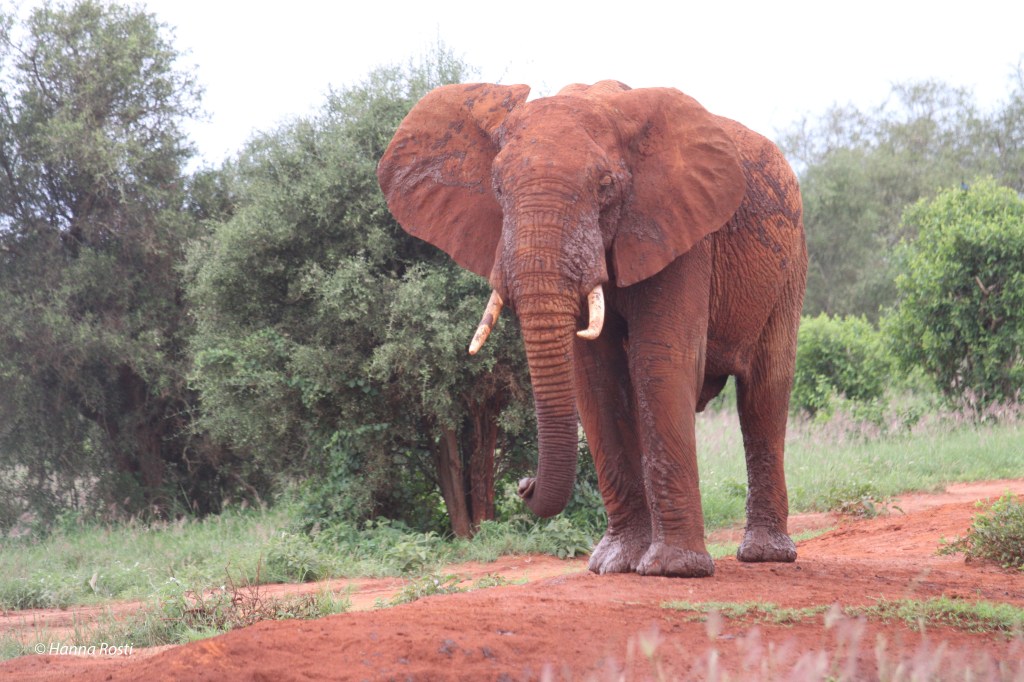
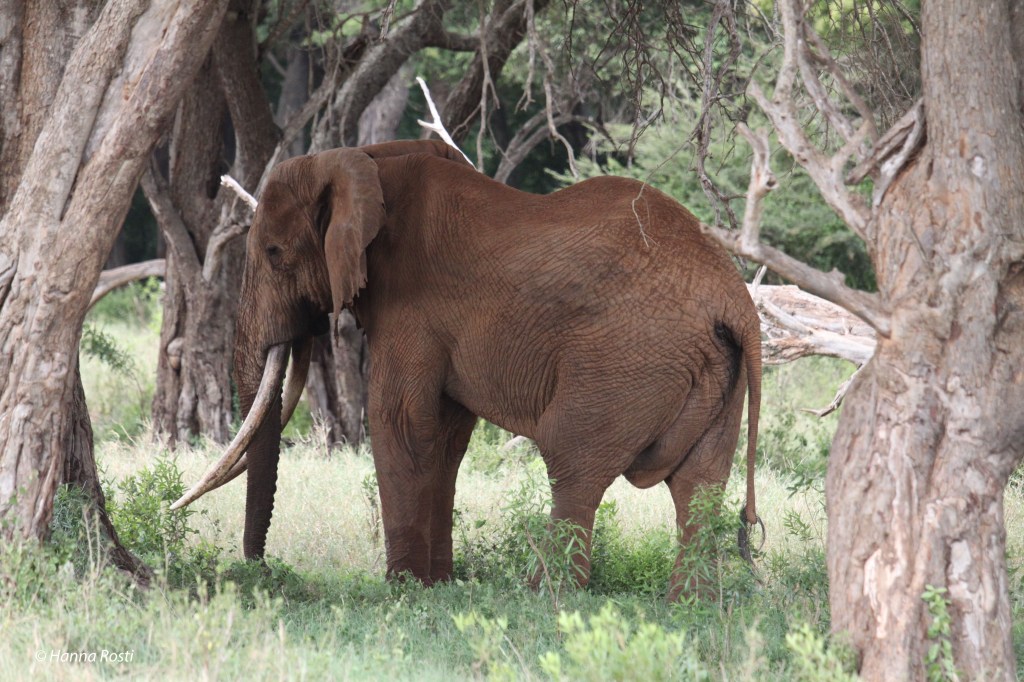
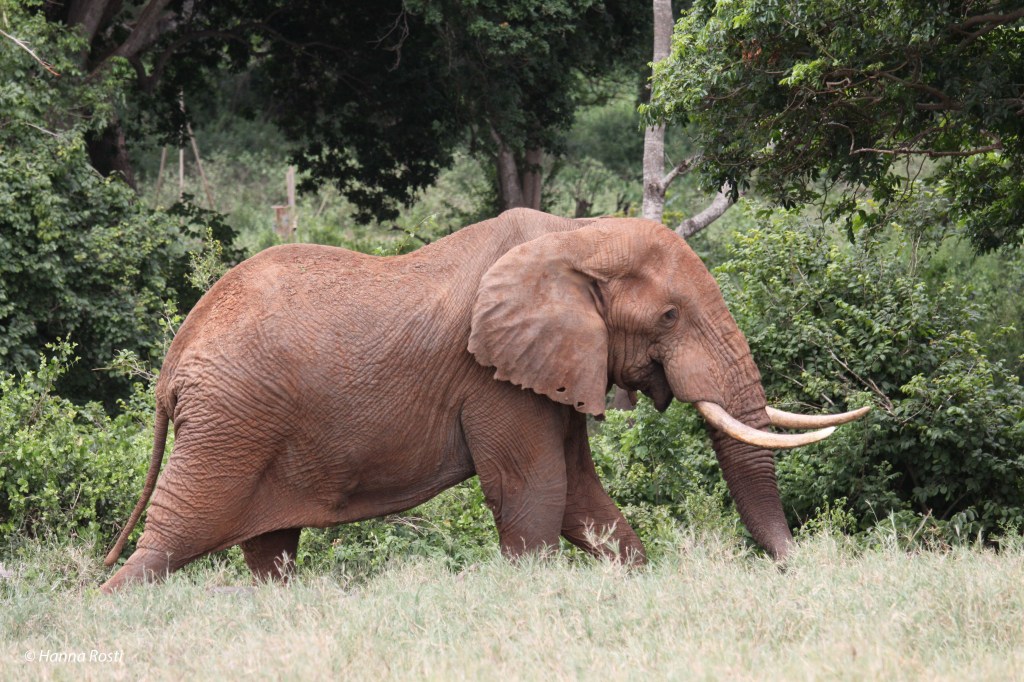
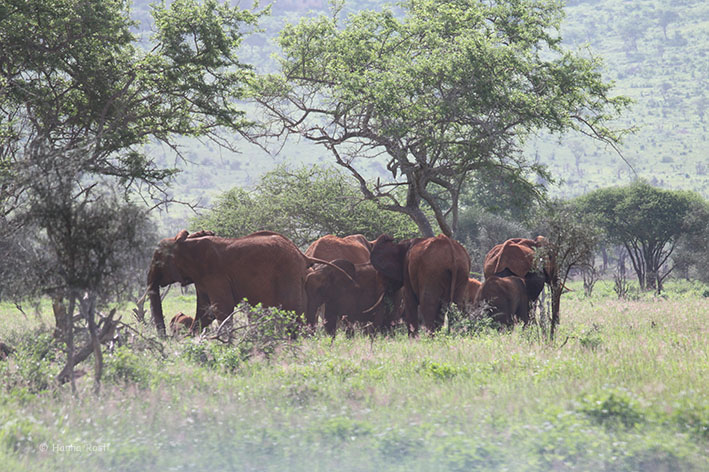
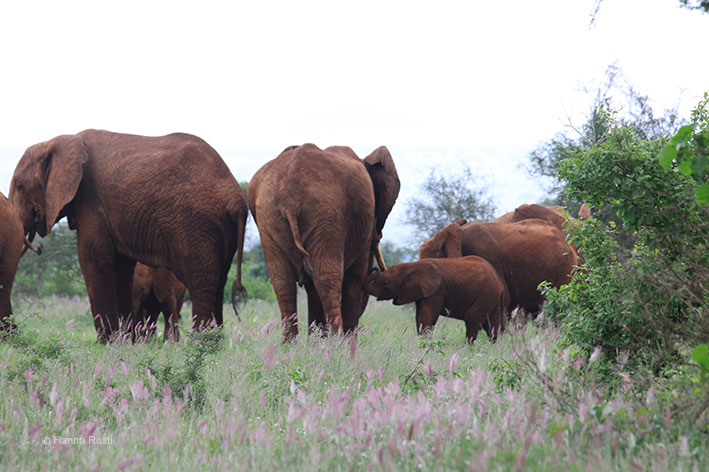
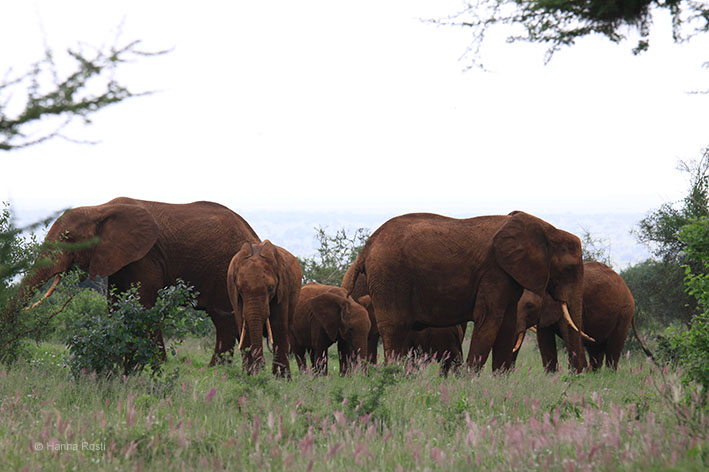
Elephant herd just outside Lumo Latika gate March 2018. Brown coloring comes from the soil.
Kenya does not allow trophy hunting for money like some other African countries. Sometimes elephants are transported to other areas when there are too many elephants in certain area. I personally value and respect Kenya for this.
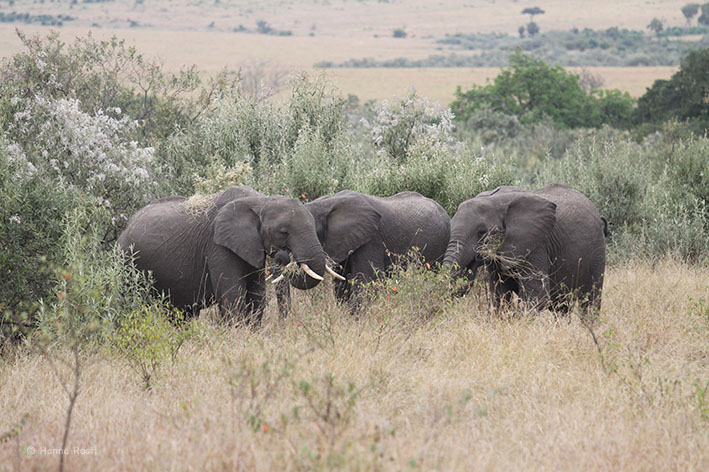
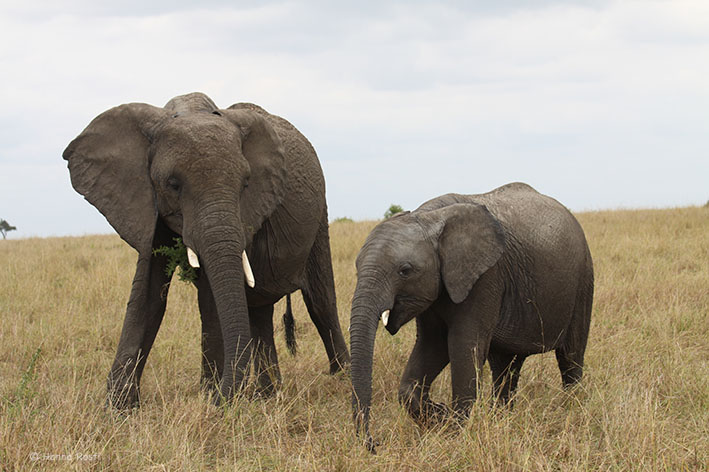
In 2018 there was 18500 elephants in Tsavo and number is increasing.
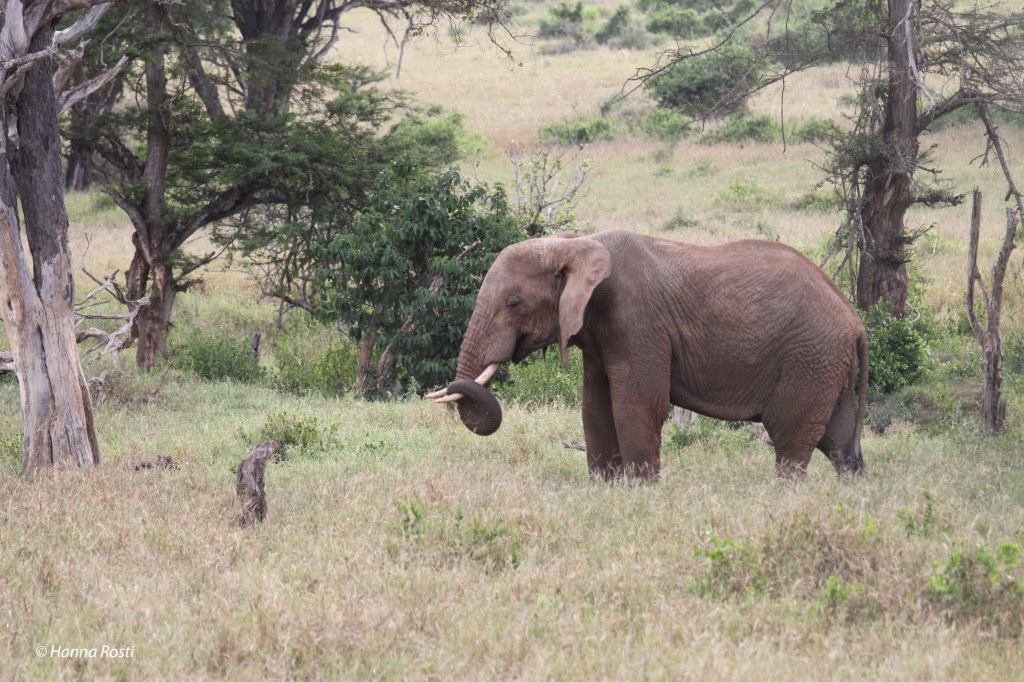
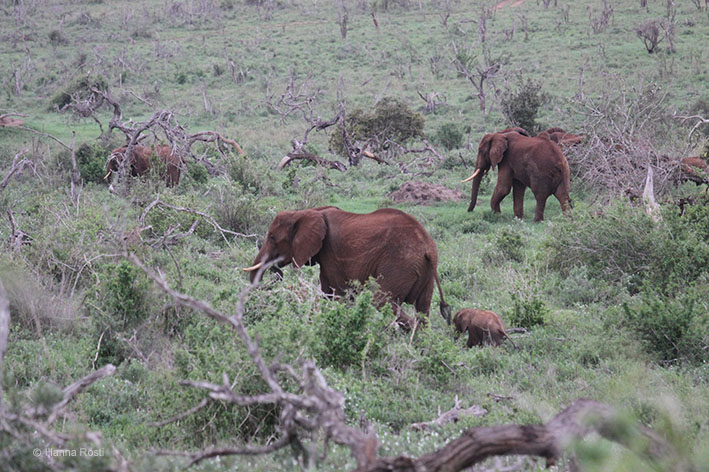
Elephants that are living in Tsavo and Lumo area still show some fearful behaviors that were caused by poaching. Most large males don’t react to people or cars, but many herds with small baby elephants begin to walk away, sometimes running, when humans are approaching.
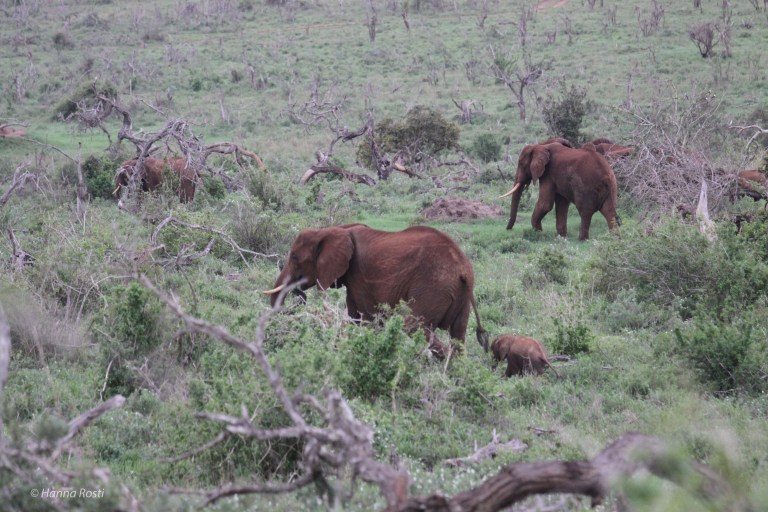
Very tiny baby elephant in Lumo March 2018. Dead trees are everywhere
Trees are pushed down by elephants
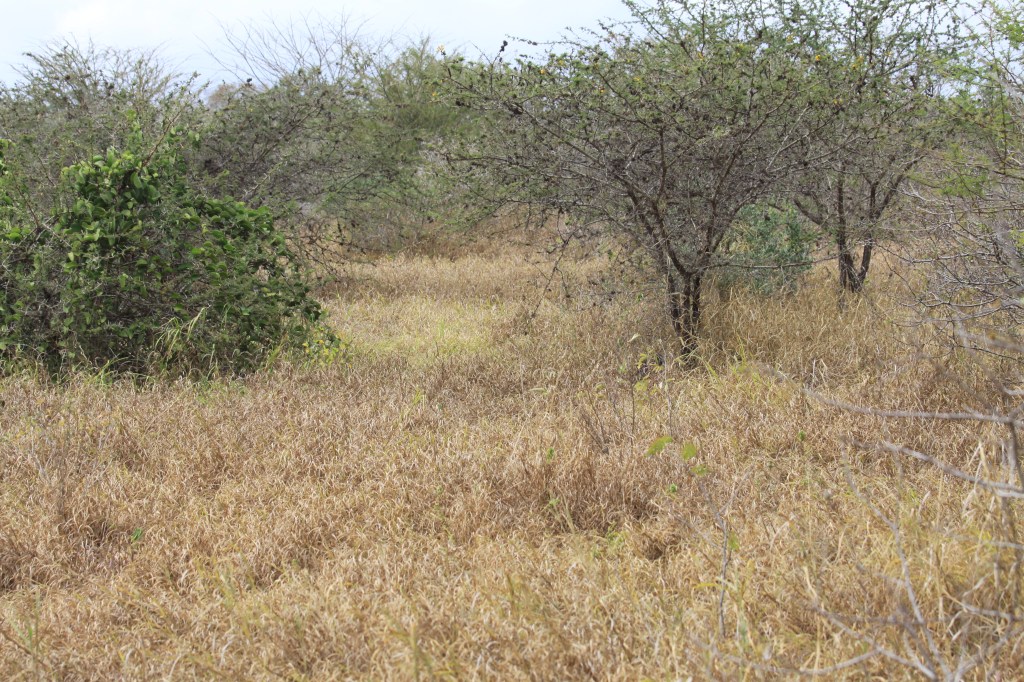
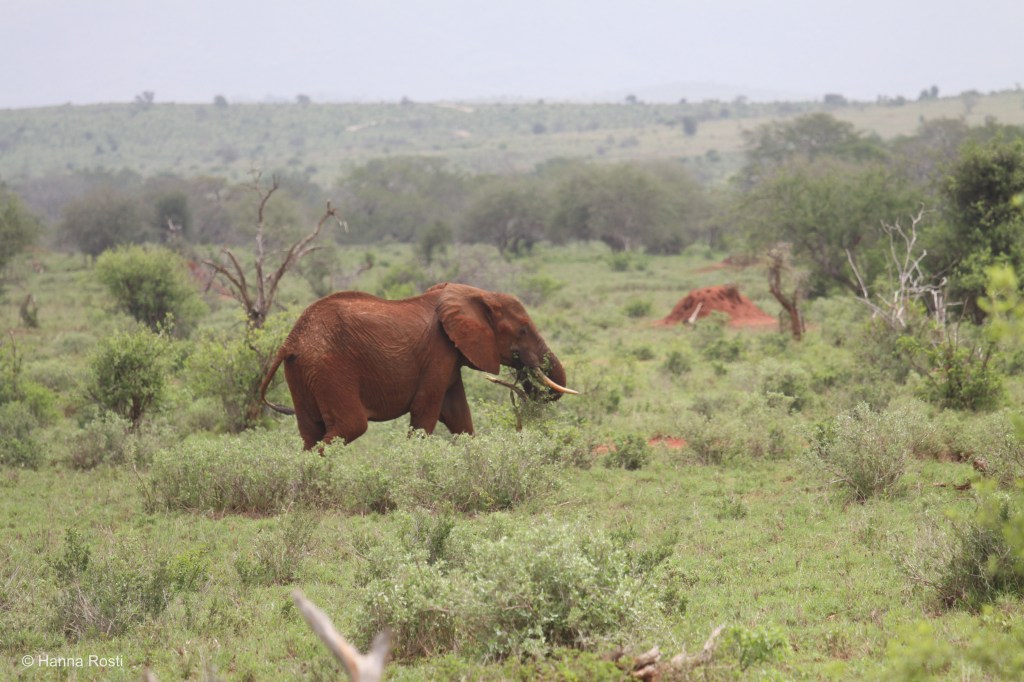
Increasing numbers of elephants are devastating to trees during dry season. Hungry and thirsty animals push the trees down. There has been dramatic change in the tree cover of savanna during just last 10 years, as can be seen in the image above.
Conversation with local rangers or other conservation people always goes for the trees, and worry about what is happening to the savanna as trees are vanishing. People love elephants and having healthy elephant population is great pride.
Elephants were hit so hard by people during worse poaching years, that it is wonderful to see the return of these majestic, emotional and intelligent animals. However, we also need to help savanna to stay inhabitable for the elephants and all other savanna lifeforms.
Tsavo and Lumo are fenced by tall electric fence. (Although I have never seen electricity running in it.) I have countless time seen how impalas jump through the fence to go browsing outside the Lumo area. Fence keeps elephants in the conservation areas up to certain point. However nothing stops elephants, if they are really going for it.
Human wildlife conflict between humans and elephants leads to loss of harvest and sometimes also loss of human lives. Local people can truly lose everything they have when elephants raide their farm.
Orphan from Bura orphanage, his mom was killed by elephants as she was protecting the crop.
Elephants may also be killed or poisoned during these raids to farms. Baby elephants may be separated from their mothers during the chaos when whole village chases elephants out of the fields. This is how human-wildlife conflict creates elephant orphans.
Maktao, (born 2017) orphaned by human wildlife conflict close to Maktau. He was rescued by Lumo ranger Dennis Kironge. Maktao is being looked after by Sheldric Foundation in Tsavo.
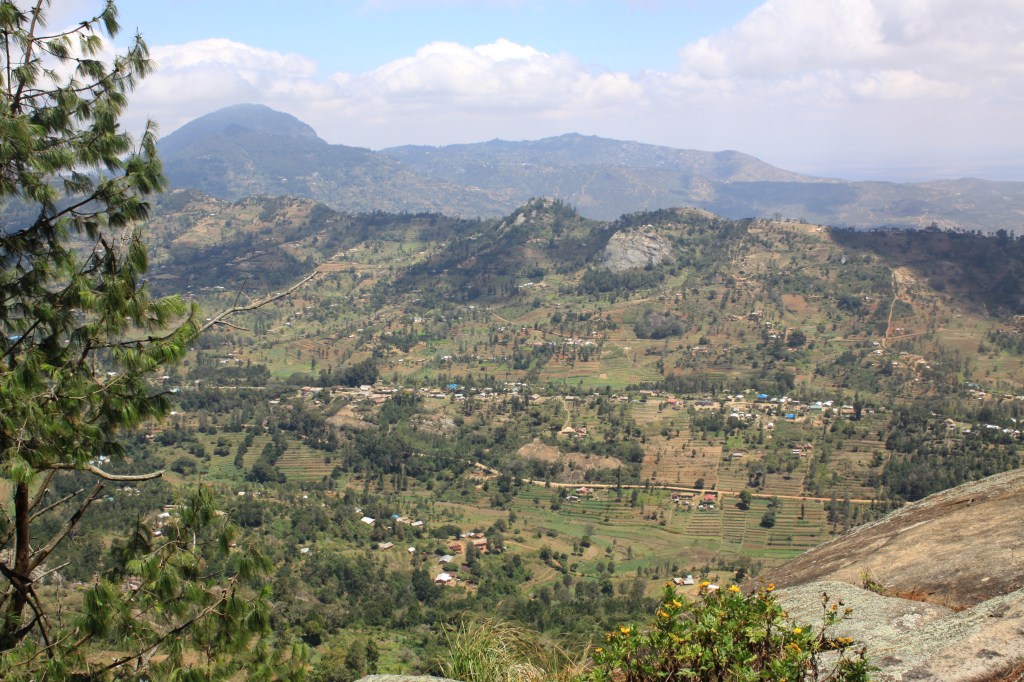
Forests of Taita Hills were replaced by farms, causing reduction in rainfall and scarcity of water
Reason why elephants become so thirsty and hungry is also related to changes in land use patterns and growth of human population. Surrounding Taita Hills is densely inhabited and old, about 30 million year old forests have been changed into fields for farming. Population growth has forced people to cultivate areas that are not very suitable for cultivation, like steep hills and areas with poor soil, or too dry areas. Fields and villages don’t attract rainwater like indigenous forest. When it rains, water runs down quickly.
Daphne Sheldric describes in her magnificent book An African Love Story, how during the most intense clearing time of Taita Hills elephants were drowning in to mud in Tsavo as soil from Taita Hills were flushed down from the hills! They were saving elephants by pulling them from the mud by cars.
Rivers bringing water to lowland savanna areas are born in Taita Hills. These old mountains used to be covered with forests – 30 million year old ancient forest. Biodiversity of those forests were incredible. During last 100 years almost all forests have been cleared for fields or forests have been replaced by exotic trees, like eucalyptus that cause even more drought. Now there is not much water left for savannas.
Now conflicts about water are common between people, and many people face difficult time during dry season, when community wells are far away.
Remnants of indigenous forests are called water towers, their significance for attracting rainwater is now understood. However 98 % of these forests have been destroyed, most during last 100 years.
When there is not enough water for people, there is even less for wildlife during dry season.
So current issue of lack of water during dry season is more severe because there is less water to begin with, and also less space for the elephants.
Hungry and thirsty elephants push trees down.
Dead trees are everywhere in Lumo March 2018. Kilimanjaro can be seen behind elephant family.
When trees disappear, biodiversity dives down
Loss of trees lead to loss of biodiversity as trees are habitats for countless insects, that are consumed by birds, that also use trees as nest sites. Large vultures and eagles need large trees. Many antelopes, like impalas, kudus, duikers, eland, and gazelles also feed on leaved during dry season when grass becomes yellow and low in nutrients. During this time leaves of many trees stay green as root system enables trees to gather water deeper from the soil. Giraffes and gerenuks are dependent on trees. Also black rhino is a browser, so in order to keep savannas good for return of black rhino, there must be trees.
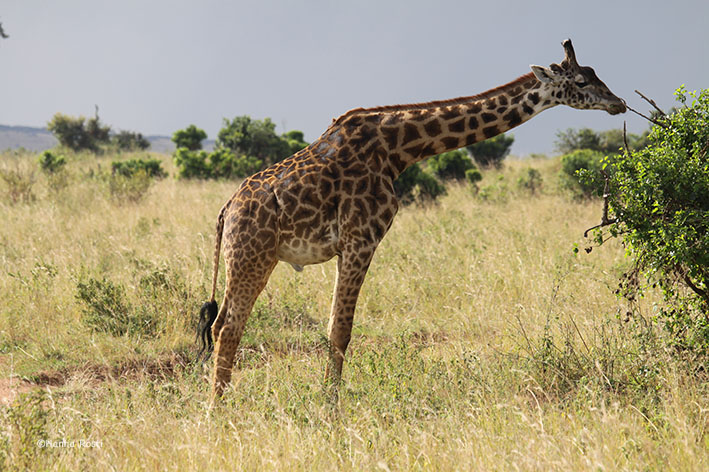
Giraffes are dependent of trees, Masai Mara August 2018.
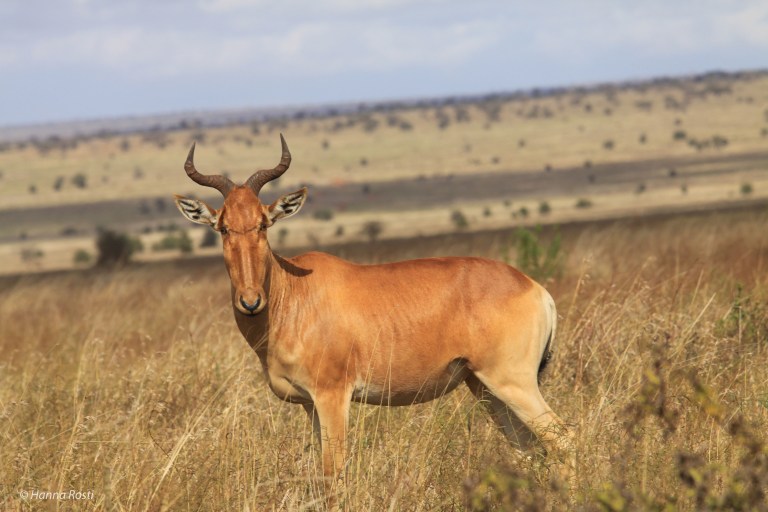
Water buffalo and hartebeest are fine with just eating grass, and there is abundant populations of both in Lumo.
Hardebeest in Lumo August 2018
Keeping trees in the savanna is important for biodiversity as all these species have intrinsic value on their own. However in Lumo people are also worried for loss of biodiversity as less animals will mean less income. As Lumo is community owned and income is spread with 5000 local people, this is extremely important for them. Most of income Lumo is bringing to local community is used for school fees, for children who could not other wise go to school at all. Will tourists come if many species disappear with trees?
How to help elephants and savanna
Mwalua Wildlife Trust http://www.mwaluawildlifetrust.org works actively to distribute water for the wildlife during dry season, and is also engaged in many other activities that help elephants and other wildlife and also mitigate human wildlife conflict. Mwalua Wildlife Trust in Facebook https://www.facebook.com/mwaluawildlifetrust/.
Sheldric Foundation takes care of baby elephants and releases them to Tsavo. Baby elephant, like Maktao here, can be adopted for 50 dollars a year. https://www.sheldrickwildlifetrust.org/orphans
There is also reforestation project in Taita Hills Wildlife Sanctuary, that belongs to Sarova Hotel. This is fenced area, that was established about 2009. Areas where reforestation takes place, need to be fenced and trees need to be watered during dry season, otherwise trees will die. This makes reforestation much more expansive, as it requires expensive fencing and long term labour.
Trees inside fenced area in Taita Hills Wildlife Sanctuary. There are abundant bird and insect fauna.
However, fence can be moved once trees are large enough to stand on their own.
Biodiversity in the enclosed area is significantly higher than right outside the fence. I have spent a day there observing insects and birds, while geographers I was with were identifying and measuring trees. Also view from higher place shows that areas outside conservation areas are growing trees and bushes.
Large enterprices could use their carbon footprint compensations for reforestations of savannas.
To keep savanna biodiversity and elephant populations healthy in current situation where water and space is limited for elephants reforestation is needed.
Large companies, including e.g. airline companies, are planting trees to compensate their carbon emissions. This would be excellent way to solve problem of elephants causing loss of biodiversity.
Fenced reforestation areas should be used and fence should be relocated in about 15 years as trees grow to keep savanna biodiversity.




 Animals of Taita, Kenya